AI Vendor Contract Clauses Every Enterprise Must Negotiate
Protect your deployment by negotiating data rights, model stability, exit clauses, and audit access.

- Written by
- Priya Subramaniam
- Published
- November 6, 2026
- Reading time
- 9 min read
What this covers
- Why the standard AI vendor contract is a vendor instrument, not a bilateral agreement
- Why AI contracts are legally and commercially different from ordinary software agreements
- The training data carve-out: the most foundational clause in any AI agreement
- Model change notification and the right to stay on the prior version
AI vendor contracts decide whether an enterprise controls its deployment or leaves the choices to the vendor by default. The essential negotiations concern data training rights, model changes, liability, verification, and exit. These are the contractual foundations of operational control, and internal AI safeguards cannot substitute for them.
Why the standard AI vendor contract is a vendor instrument, not a bilateral agreement
The standard agreement is drafted by one side for that side’s benefit. Its default language minimizes vendor obligations while preserving vendor rights, leaving the enterprise to identify and correct the imbalance. A signed agreement can bind both sides even when they do not share the risk evenly. Every provision accepted without negotiation preserves that allocation, including provisions whose consequences become apparent only after deployment.
An enterprise can operate prompt filters, model gateways, audit pipelines, and kill switches while its agreement permits broad data reuse or silent model replacement. Those controls govern only the enterprise’s use of the service. Opaque subprocessors and an unusable exit process can therefore leave a carefully governed deployment exposed beyond the enterprise’s own systems.
Why AI contracts are legally and commercially different from ordinary software agreements
AI changes what the enterprise buys and what it can reasonably validate. Traditional software comes with “works as specified” warranties, while AI vendors default to “best effort.” Customer inputs may also become training material, and a general privacy statement may not explain what happens after submission. The underlying model can change on the vendor’s schedule, even when the enterprise’s workflow has not changed.
These differences change how commercial risk is shared. A mispriced loan, flawed legal summary, or incorrect clinical recommendation creates exposure for the enterprise deploying the system. A defensible production agreement must address uptime, response time, and model accuracy rather than treating access to features as proof that the service works acceptably.
The training data carve-out: the most foundational clause in any AI agreement
The enterprise should require an explicit, affirmative prohibition on training with its data. Without that restriction, proprietary inputs such as customer lists, contracts, clinical data, and legal strategy may become raw material for a commercial model the vendor controls. A privacy commitment does not necessarily prohibit this use.
A composite example makes the exposure concrete. A company submits customer call recordings under an agreement that has no training prohibition and does not require deletion. It has not secured a contractual basis to prevent training on those recordings or require their removal when the relationship ends. The gap exists before any dispute arises.
The enterprise should ask for a binding training prohibition and distinguish it from retention and deletion commitments, which address different uses of the same data. Most major vendors accept training prohibitions for paid enterprise tiers, especially when the contract is worth enough to them. Resistance is greater at consumer and low-tier levels, making the choice of commercial tier part of the negotiation.
Model change notification and the right to stay on the prior version
A training prohibition does not stabilize the service itself. A tool tested and approved in one quarter may rely on a different model the next, even though the enterprise continues to use the same workflow. A silent update can break integrations or degrade output quality. The vendor’s default terms may impose no notification obligation at all.
The enterprise should therefore negotiate advance notice of model changes and the right to remain on the prior version while assessing the replacement. In regulated verticals, approval of one version does not establish that a different version is suitable for the same clinical, financial, or legal task. Without enough time to move to the replacement, the enterprise has to do the validation work but cannot control when it must do it.
Termination rights when model behavior materially changes
Notice without an exit right is a warning without a remedy. If a replacement model adversely affects a workflow and the vendor cannot remediate the problem, the enterprise needs a contractual right to terminate. Otherwise, it may remain commercially committed to a service that no longer supports its approved use, a particularly consequential outcome for agents executing steps in production workflows.
A provision tied to material degradation in the enterprise’s workflows and the vendor’s inability to remediate is more objective than a general right to leave whenever the buyer dislikes an update. Vendors can assess and underwrite that narrower obligation, which makes agreement more attainable. Vendors often push back hard on this provision, but refusing any termination right tied to model degradation is a contract red flag.
Indemnification for AI outputs and why the liability cap is the hidden variable
Operational failure can also become a financial claim. When an AI system contributes to a mispriced loan, the enterprise faces consequences that may bear little relation to what it paid for the tool. An indemnification clause must therefore be read together with the agreement’s liability limits.
Honigman LLP states that most agreements cap total liability, including indemnification, at 12 months of fees. For a low-cost tool handling high-sensitivity data, that amount may cover only a fraction of the exposure. The cap can neutralize the apparent protection. The enterprise should ask for a meaningful multiple of annual fees for direct damages from vendor error.
Coverage also needs to match the claim involved. IP indemnification is not a general answer to every harmful AI output, and vendor provisions differ widely in breadth, conditions, and exclusions. The enterprise needs to find out which claims are covered and whether that coverage falls within the general cap. Neither the heading “indemnification” nor a broad opening sentence answers those questions.
Audit rights: the clause that makes every other promise checkable
Audit rights give the enterprise a contractual basis to test vendor commitments. A training ban or data-handling promise gives the buyer little assurance about what happens in practice if it cannot get proof that the vendor follows it. Verification also supports the enterprise’s understanding of failures relevant to indemnification. Without it, oversight depends on what the vendor volunteers.
CFOs, board audit committees, and risk functions need a way to check whether the contract’s protections work in practice. The enterprise should retain verification rights and, where appropriate, anchor them in recognized frameworks such as NIST AI RMF or ISO/IEC 42001. These rights are easily dropped under pressure to close a deal, precisely when they should remain non-negotiable.
Disclosure, subprocessors, and the responsible AI tradeoff clause
Verification depends on knowing what is being assessed. The retreat in vendor transparency in 2025 makes voluntary publication an unreliable substitute for contractual disclosure about the model and the parties involved in delivering it. An enterprise cannot assess its exposure fully if it does not know which subprocessors handle its data. The agreement should require advance notice before subprocessor additions or removals and give the enterprise a right to object to new subprocessors.
Transparency must also reach choices that affect deployment suitability. A responsible AI tradeoff clause addresses what the vendor sacrificed when making those choices, rather than allowing a general responsible AI commitment to stand in for an explanation. The buyer needs to understand the compromise. Without that understanding, it cannot judge whether the resulting model fits its intended use.
The clause should therefore require disclosure of relevant responsible AI tradeoffs and their implications for the deployment. This is distinct from asking the vendor to promise that no tradeoffs exist. It makes the basis of the vendor’s decision visible so that the enterprise can make its own informed decision about acceptance.
Incident reporting: the clause that connects the contract to operational reality
Once the enterprise knows what is running, it also needs timely notice when something goes wrong. Stanford HAI’s 2026 AI Index Report documented a sharp rise in AI incidents in 2025. That trend strengthens the case for a defined incident-notification window. A short security-breach notification window is a standard benchmark in 2026 enterprise agreements.
Notification connects vendor operations to enterprise accountability. An internal audit pipeline cannot substitute for information about a vendor-side failure that the enterprise has not been told about. The contract should make that information available within a defined period so that operational teams and governance functions can respond. For the board to be accountable, it needs to know what happened in time to respond, even if it already has a right to an explanation later.
Data return, deletion, and exit terms: the clause enterprises negotiate last and need most
Closing an account does not establish that its data has been deleted. Without explicit exit terms, information may remain with the vendor and its subprocessors indefinitely after termination. A training prohibition alone does not resolve that problem. The agreement needs obligations covering data return, deletion, and the exit process itself.
These obligations must extend through and after termination. The enterprise should negotiate data portability and an exit mechanism that makes departure operationally usable. Otherwise, the cost and difficulty of leaving can preserve the vendor’s leverage after the service no longer meets the enterprise’s needs. This is where vendor-favorable drafting can become operational dependence.
Refusal to accept any deletion obligation or exit mechanism is a contract red flag. Such a refusal leaves the enterprise without a workable endpoint for either the commercial relationship or the handling of its data. The time to negotiate exit is before signing.
What the clause map looks like by deployment risk tier and vertical
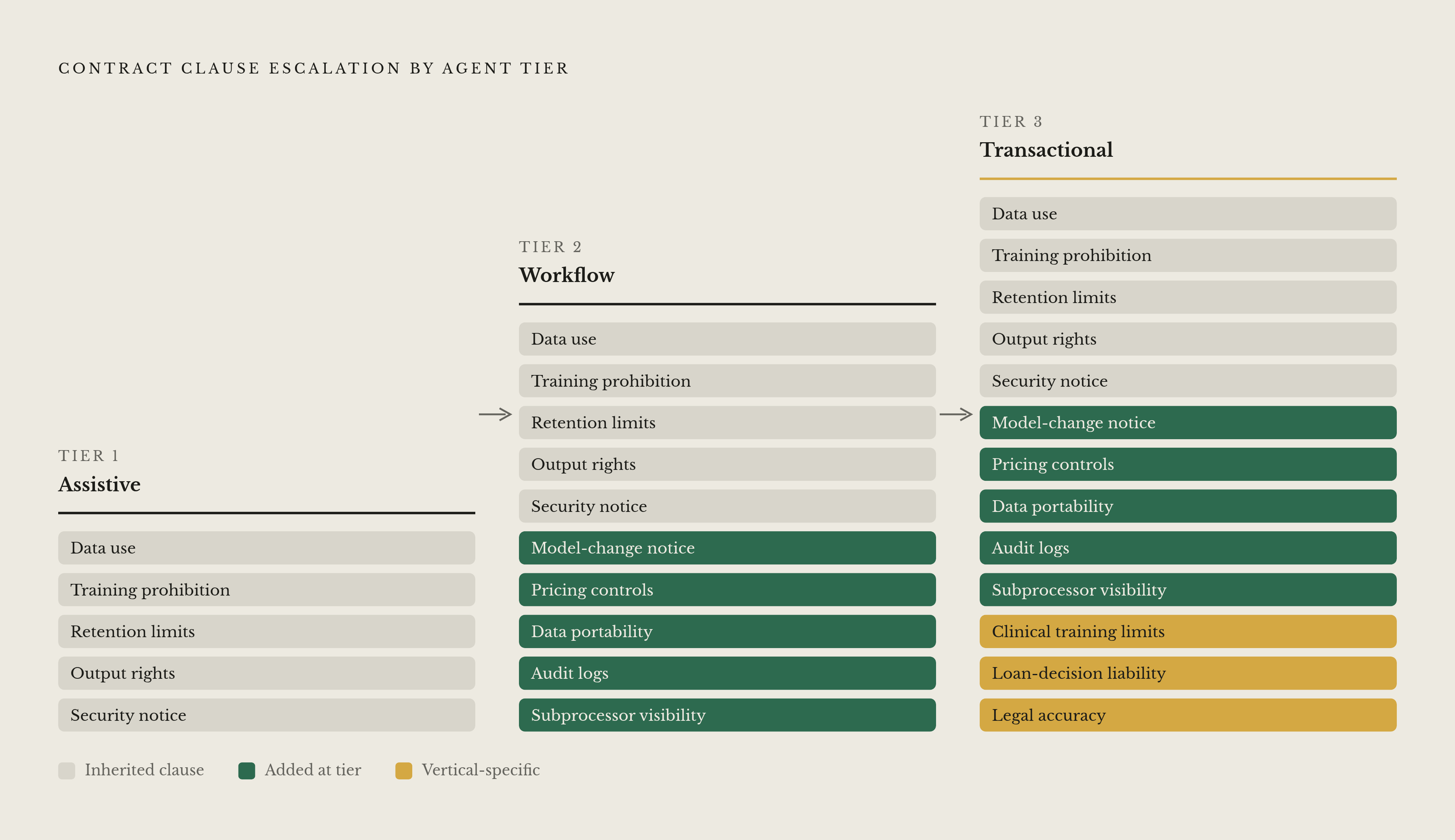
Priorities should follow what the agent does and whom it affects. Assistive agents that summarize, draft, or recommend without executing need, at minimum, provisions covering data use, training prohibition, retention, output rights, and security notice. Human review does not remove those baseline requirements. Sensitive information remains sensitive even when the system cannot act on its own.
Workflow agents add exposure because they execute steps in an operational process. Their agreements need model-change notification, pricing controls, data portability, audit logs, and subprocessor visibility in addition to the assistive baseline. Transactional agents operating in regulated data environments require a materially different contractual framework from a drafting tool.
Vertical requirements sharpen that assessment. Clinical data makes training and handling restrictions central, while a loan-decision workflow makes model degradation and downstream liability especially consequential. Legal summaries show why a service must be accurate as well as available, especially when the underlying model changes. The enterprise should use these features of its deployment to decide which protections it must keep. Contractual readiness is part of production readiness.
How to run the negotiation: sequencing, leverage, and what to do when vendors resist
The enterprise should bring up what it needs in the contract before agreeing on price. There may be less room to negotiate once the deal feels done, while commitments over several years and deployments across several departments can give the buyer more leverage. An AI Operations Audit gives the enterprise a basis for negotiation by checking whether it is ready for deployment, how data flows, and what compliance requires. It gives counsel specific reasons for each requested protection.
The negotiation should begin with more than the enterprise expects to win. Related provisions should be bundled rather than raised piecemeal, with narrower scope on a lower-priority clause exchanged for stronger protection on a higher-priority one. Tradeoffs need explicit limits. For model-change notice, the enterprise should hold to a defined minimum that protects operational continuity even when the vendor presses for a shorter window.
The enterprise should refuse to sign if the vendor rejects any training prohibition, offers no liability beyond “reasonable commercial efforts,” requires auto-renewal without a meaningful cancellation window, or will not name its subprocessors. Audit rights should not become a last-minute concession to speed signature. Negotiation is corrective because the vendor’s standard form begins with an allocation of control designed for the vendor.