EU AI Act Obligations for AI Deployers vs. AI Providers
Companies must map AI roles system-by-system to avoid compliance gaps.

- Written by
- Mirela VanthorpeSenior EU Correspondent
- Published
- October 12, 2026
- Reading time
- 10 min read
- Sources cited
- 3 sources ↓
What this covers
The EU AI Act does not sort companies into permanent categories. It sorts systems into roles, and a single enterprise can hold two different roles on the same afternoon. A system you build as a hiring model in-house makes you a provider for that system. A vendor's customer-service chatbot deployed down the hall makes you a deployer for that one. The obligations attached to each role are different in kind, not just in degree, and getting the role wrong for even one system creates a compliance gap that the organization may not discover until an auditor asks for a document that was never created.
Provider and deployer as role designations, not company labels
Under Article 3 of the Act, a provider is any person or organization that develops an AI system, or has one developed on its behalf, and places it on the EU market or puts it into service under its own name or trademark. A deployer, by contrast, is any person or organization using an AI system under its own authority in a professional context. That second definition covers most European enterprises, because they overwhelmingly buy, configure, and run AI tools rather than build them from the ground up.
The Act recognizes four more operator roles beyond these two: importers, distributors, authorized representatives, and product manufacturers. Together with providers and deployers, these six categories make up what Article 3(8) calls an "operator." But the informal language teams tend to use internally doesn't map cleanly onto any of this. "AI user" and "AI vendor" are not precise terms under the Act, and relying on them in an internal compliance document is a good way to miss which formal obligations actually apply.
Territorial reach extends further than many organizations outside the EU assume. The Act applies whenever an AI system is used within the EU or when its outputs are used there, regardless of where the provider sits, and enterprises running AI agents across inventory management, case review, or patient workflows, for instance, often occupy both the provider and deployer roles simultaneously for different systems running on the same day, so role determination has to happen system by system rather than once for the whole organization.
The enforcement timeline that makes role clarity urgent right now
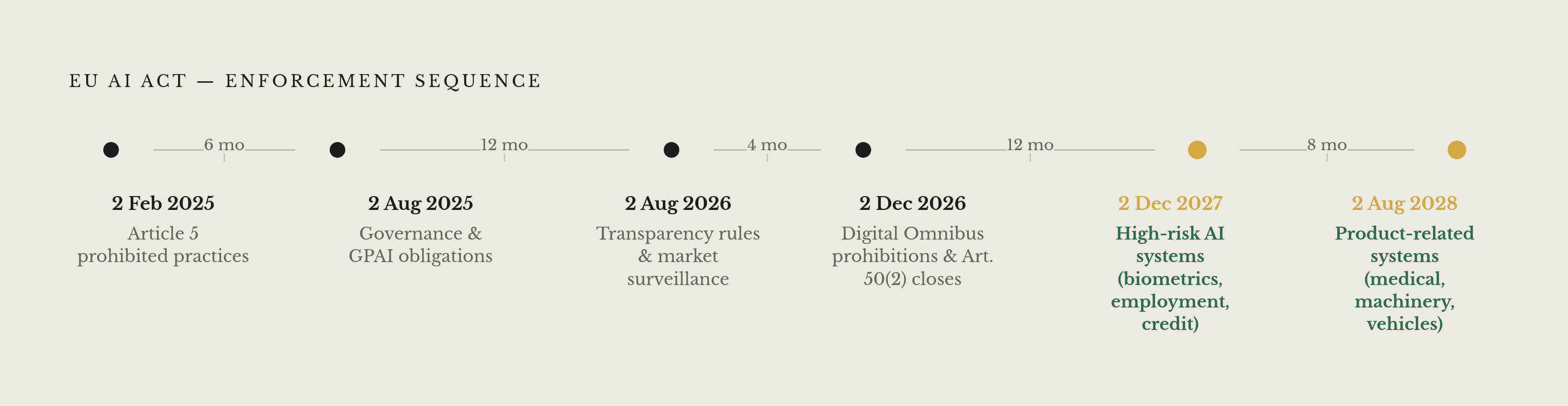
Enforcement is not a future event. Prohibited practices under Article 5 have applied since 2 February 2025. Governance rules and obligations for general-purpose AI models kicked in on 2 August 2025. From 2 August 2026, Article 50 transparency obligations came into force, with national market surveillance authorities starting enforcement and the European Commission's AI Office holding enforcement power over general-purpose AI model providers specifically.
More change arrived on top of that baseline. New Article 5 prohibitions added by the Digital Omnibus apply from 2 December 2026, and the Article 50(2) transition period for systems placed on the market before 2 August 2026 also closes on that same date, 2 December 2026. The high-risk compliance dates that many organizations had treated as fixed also moved. Chapter III obligations for Article 6(2)/Annex III high-risk systems, covering biometrics, employment, credit, education, critical infrastructure, law enforcement, migration, and justice, now apply from 2 December 2027. Chapter III obligations for Article 6(1)/Annex I product-related systems, covering medical devices, machinery, and vehicles, apply from 2 August 2028. These dates moved because of Regulation (EU) 2026/1744, the Digital Omnibus on AI, which entered into force 27 July 2026. Treating 2 August 2026 as still the operative high-risk deadline is a factual error at this point, not a simplification.
None of this buys as much breathing room as it might sound. The 2027 and 2028 dates feel distant only until the scope of the work between now and then is counted. The compliance path the Act's own structure implies runs in sequence: determine whether the Act applies, identify the operator role for each system, screen for prohibited practices, classify high-risk and transparency exposure, then map the specific duties and transition rules that attach to that role. If you skip ahead to the high-risk deadlines without doing that sequencing work first, you end up compliant on paper for the wrong obligations.
Provider obligations: the full pre-market and lifecycle obligation stack
Providers of high-risk AI systems carry the heaviest obligation load in the Act, and all of it has to be satisfied before the system reaches the market or goes into service. There is no grace period for a system that is already live.
Before a system reaches the market, a provider has to register it in the EU database, conduct a conformity assessment, and affix CE marking where it's required. Data governance obligations require quality controls over training data, documentation of data sources and preprocessing methods, and validation that the data actually represents the use cases the system is meant to serve.
If providers placed systems on the market before 2 August 2026, they got a transitional window to meet Article 50(2) obligations, and that window closes on 2 December 2026.
One provider obligation matters more to the next section than any other: providers have to give deployers clear instructions for use, including how to implement human oversight. That instruction set is not a courtesy document. What happens on the deployer's side of that line is the deployer's own legal problem.
Deployer obligations under Article 26, independent of the vendor's compliance
Provider obligations are designed for organizations that build AI systems and place them on the market under their own name. Enterprises that procure and deploy agents built by vendors sit in the deployer role, and Article 26 gives that role its own obligation stack, anchored to how a system is implemented and used. A vendor's conformity assessment, its audit trail, its certification: none of it substitutes for the deployer's own documentation and controls.
A deployer has to use the system in accordance with the provider's instructions for use. Operation logs have to be retained for at least six months, kept in an automatic and documented manner, and made available to authorities on request. Human oversight has to be assigned to competent personnel who actually have the authority to intervene, and those personnel have to be trained and monitored for the risks the system poses.
Where a system will be deployed in a public-sector or otherwise sensitive context, the deployer has to conduct a fundamental rights impact assessment before deployment begins, inform affected workers ahead of time, and report serious incidents to the provider promptly. A voluntary Code of Practice on Transparency of AI-Generated Content gives organizations a structured path to demonstrate compliance, and signatories can rely on its measures as evidence, but signing it is optional while the underlying Article 50 obligation is not.
Article 4 cuts across all of this. Providers and deployers both have to take measures supporting AI literacy among staff and anyone else operating a system on the organization's behalf, with training proportionate to each person's role, knowledge, and the context in which the system is used. Article 26(2) requires that the people assigned to oversight have the competence and training the role demands, so a deployer's training program and its oversight documentation are the same compliance obligation viewed from two angles.
At this stage, people most often read the provider's conformity assessment and technical documentation as proof that the hard compliance work already happened upstream. Article 26 does not work that way. It assigns the deployer a parallel set of obligations that exist whether or not the vendor did everything right.
The Article 25 reclassification trigger: how a deployer becomes a provider
Picture an enterprise that licenses a vendor's credit-scoring model, then fine-tunes it on the organization's own historical loan data to improve accuracy for its customer base.
Substantial modification covers more than full retraining. In a chain of AI agents, the compliance boundary extends to every agent performing a high-risk function, so a multi-agent architecture multiplies the number of places reclassification can happen.
The objection that comes up most often in practice, that the vendor contract names the vendor as the provider, does not hold up. The sources on this point are clear that the obligation shifts when the modification happens; they are less precise about exactly where the line sits for borderline cases, and that imprecision is itself a reason to build the screen in early. Determining a project's purpose and stakeholder roles before the technical work starts, rather than after, is the only way to catch a reclassification risk before it has already occurred. Any team planning to fine-tune a purchased system, restructure its pipeline, or expand its agentic scope needs that screen run first, not as a postmortem.
High-risk classification: the Annex I and Annex III systems enterprise teams are already running
High-risk status depends on what a system does and where it operates, not on the underlying model or technology, and a lot of what enterprises are already running sits squarely inside Annex I or Annex III without anyone having labeled it that way.
There are two routes into high-risk classification. Article 6(1) and Annex I cover AI systems used as safety components of products, or systems that are themselves products, under existing EU harmonisation legislation, such as medical devices, machinery, and vehicles; the applicable Chapter III date for these is 2 August 2028. Classification has to be done at the level of use, not technology. A system cannot be waved through as low-risk just because it's described internally as "a chatbot" or "a machine learning tool."
Article 6(3) carves out certain Annex III systems that don't pose a significant risk of harm, but that carve-out has a hard limit: any Annex III system that performs profiling of natural persons is always treated as high-risk, no exception available.
Sector adds another layer on top of this. In legal services, most contract lifecycle management features fall into limited or minimal risk, but anything touching employment contracts, worker management, or access to services needs a fresh look against Annex III, and AI that automates consequential client-facing decisions, such as contract risk scoring or litigation outcome prediction, likely crosses into high-risk territory. A simple customer-facing chatbot faces only minimal transparency requirements. An autonomous agent operating in credit scoring, hiring, regulatory reporting, or critical infrastructure decisions faces the entire high-risk obligation stack, even if both started from the same underlying model.
The five evidence gaps that auditors find most often in deployer compliance reviews
Most deployer compliance failures are missing documents that Article 26 requires and that an auditor can ask for and verify in a single request.
Deployer audits most often turn up five gaps. The fifth is the absence of a formal incident escalation procedure: no documented process exists for detecting a serious incident, escalating it internally, and reporting it to the provider.
The AI literacy gap makes all five worse. Article 4 compliance requires a training inventory that maps every system in use to the staff roles that operate it, a training program matched to those roles, and records showing who completed that training and when. Penalty exposure for deployers who fail on these fronts runs up to €15 million or 3% of worldwide annual turnover, covering failure to maintain required documentation, failure to report serious incidents, failure to conduct a FRIA where one was required, failure to implement human oversight, and failure to cooperate with supervisory authorities.
Building a role-and-risk map as the foundation of a deployable compliance program
None of this starts with a policy document or a training deck. It starts with a complete, system-by-system inventory that records role, risk classification, and obligation exposure for every AI system an organization runs.
That inventory has to catalog every system across the enterprise: agents built in-house, third-party vendor agents, agents embedded inside SaaS tools, and any customer-facing agent reaching users in EU markets. Each entry needs a business owner, the system's purpose, the population it affects, the data sources it touches, the tools or systems it can call, the markets it operates in, its level of autonomy, and the human review points built around it. Scope determination has to follow the exact text of Article 2, not an assumption that a product's marketing label implies an exemption.
For every system in that inventory, the compliance team then has to determine its operator role (provider, deployer, or a deployer reclassified as a provider under the Article 25 screen), check it against Article 5 prohibited practices before anything else, classify its high-risk exposure against Annex I and Annex III with the specific entry and intended purpose documented, and map the obligation set and transition deadline that role and classification carry.
This is the work an AI Operations Audit is built to structure and move faster. Eigenomic's version of that audit is designed for enterprise teams trying to find where AI automation can save real time, and it covers how work actually gets done day to day, a ranked list of what to automate first, the ROI math behind each option, and a 90-day plan for implementation. Eigenomic builds and deploys production agents rather than prototypes, so its audit methodology is grounded in the same documentation and oversight architecture that Articles 26 and 15 actually require, not borrowed from generic IT governance frameworks. For an enterprise that discovers through the audit that it has already crossed the Article 25 substantial modification threshold, Eigenomic can carry the engagement into the full provider compliance build: conformity assessment preparation, quality management system design, and technical documentation, from the same relationship.
Other paths exist and serve different parts of the problem. The inventory, the role mapping, and the risk classification remain the starting point regardless of which of these an organization turns to next, since none of the later steps hold up on a foundation that was never built.
Methodology & sources
- Deployer obligations under the AI Act: Implications for employers from 2 August 2026 - DLA Piper GENIE
Provided detailed analysis of Article 26 deployer obligations, the Article 50 transparency requirements, the voluntary Code of Practice on AI-Generated Content, and the Article 4 AI literacy requirements that structure the deployer obligations sections.
- Guidelines on transparency obligations for providers and deployers of certain AI systems
Supplied the European Commission's official guidance on transparency obligations for providers and deployers of certain AI systems, informing the article's treatment of Article 50 requirements.
- EU AI Act High-Risk Deadline: Enterprise Readiness Gap
Provided analysis of enterprise readiness gaps and high-risk compliance deadlines, informing the article's discussion of the shifted Chapter III obligation dates and the compliance sequencing work required before those deadlines.