California AI Transparency and Automation Disclosure Requirements for Businesses

- Written by
- Mirela Vanthorpe
- Published
- November 2, 2026
- Reading time
- 9 min read
- Sources cited
- 3 sources ↓
What this covers
California’s AI transparency and automation disclosure requirements form a compliance stack. Businesses must check each system against rules that overlap in how they cover model development, generated content, and significant decisions. Businesses should map those obligations together, then build the operational controls and calendar needed to satisfy each layer independently.
Why California's AI rules can't be read one law at a time
The familiar approach to regulation is to find the relevant law, read its requirements, and organize compliance around it. That approach falls short for California’s AI rules because several laws can apply to the same deployment for different reasons. Their applicability thresholds, enforcement regimes, and operative dates differ. One statute cannot supply the whole answer. A business may fall outside a rule for providers but still have to meet consumer-rights requirements or duties passed down through its contract with its model supplier.
That fragmentation makes the business’s role as important as the technology it uses. Developing a model, licensing it, generating content, and applying its output to consumer decisions are distinct activities within the stack. California’s broad jurisdictional reach also means that serving California consumers through a digital business can bring companies elsewhere within scope. Businesses must therefore ask whether California regulates the system and which obligations attach to each activity.
The four enacted layers and what each one actually covers
The California AI Transparency Act, or CAITA, governs covered providers of publicly accessible generative AI systems in California with over one million monthly visitors or users. Its provider obligations become operative on August 2, 2026. These include a free AI detection tool, an option for users to obtain manifest disclosure, and latent disclosures embedded in generated image, video, and audio content. This layer addresses the provenance of generated media. Its licensing rules also require licensees to preserve disclosures.
The Generative AI Training Data Transparency Act, or AB 2013, applies to developers of generative AI systems or services intended for Californians, including systems substantially modified on or after January 1, 2022. From January 1, 2026, it requires developers to post a summary of training datasets on a website that the public can access. The required categories cover sources and owners, intended-purpose contributions, data types and counts, intellectual property status, and purchase or licensing status. They also cover personal and aggregate consumer information, cleaning or processing, collection periods, first-use dates, and synthetic data use. The statute leaves “high-level” undefined, so developers must judge sufficient disclosure without exposing proprietary methodology. Each substantial model modification requires an update.
AB 2013 does not spell out a penalty schedule. Noncompliance can nevertheless create exposure under California’s Unfair Competition Law, under which the Attorney General requires no injury showing. The Transparency in Frontier AI Act, or SB 53, addresses a different developer category. Signed September 29, 2025, and effective January 1, 2026, it is California’s first law specifically targeting frontier model developers. It requires publication of frontier AI frameworks, reporting of critical safety incidents, and whistleblower protections.
The California Privacy Protection Agency’s Automated Decision-Making Technology regulations address business use. Finalized under the CCPA/CPRA, the ADMT regulations took effect on January 1, 2026, while consumer-rights compliance is required by January 1, 2027. Covered significant decisions include financial or lending services, housing, education, employment or independent contracting opportunities or compensation, and healthcare services. The core rights are pre-use notice, opt-out, and access to information about the ADMT use. This is the stack’s decision-focused layer. Its overlap with development and content rules creates the central compliance problem.
How the layers interact when a business deploys a single AI system
A customer service chatbot shows why a single deployment needs several scope assessments. If it generates image, video, or audio, the business must assess CAITA’s content-disclosure requirements. If it influences credit, employment, or healthcare decisions, the ADMT notice and opt-out requirements become relevant. If the business developed or fine-tuned the underlying model, AB 2013’s training-data documentation requirements also require assessment. The chatbot’s interface does not define its regulatory scope. Its outputs, decision-making role, and development history do.
The developer-deployer distinction adds a contractual dimension. CAITA’s core obligations fall on covered providers, but their licensing agreements must require licensees to preserve latent disclosure capability. A company integrating a third-party generative AI engine through an API may therefore have metadata obligations even when it falls below the one-million-user threshold. The statutory threshold is not a complete shield. The contract can transmit duties that a provider-only applicability review would miss.
For the chatbot that both generates covered content and participates in significant decisions, neither disclosure substitutes for the other. Embedded provenance identifies generated media, while ADMT notice and opt-out rights address the use of automation in a consequential decision. There is no consolidated compliance pathway. Enforcement exposure can also accumulate independently, with CAITA providing for $5,000 per day and CCPA/ADMT and SB 53 providing higher per-violation amounts. A checklist confined to one instrument leaves other sources of liability unresolved.
Where ADMT obligations land hardest: automotive, legal, and healthcare
ADMT reaches a broad range of enterprise deployments because significant decisions sit within ordinary business workflows. In automotive, AI-driven financing and insurance pricing tools that determine credit terms or coverage eligibility for California consumers trigger pre-use notice and opt-out obligations. For automation that connects manufacturing data, dealership operations, customer engagement, and after-sales service, businesses need to check more closely whether AI affects a covered consumer outcome. Not every automated touchpoint is a significant decision. Dealership chatbots also face California’s prohibition on affirmatively representing themselves as human where a reasonable customer could be misled.
Legal organizations face a similar distinction between workflow support and consequential decision-making. Production AI increasingly spans document intake, review, summarization, and filing. Where those workflows influence decisions within ADMT’s covered categories, notice and access obligations attach. The clearest employment examples are AI-assisted hiring and performance review. Case strategy or client outcomes require assessment against the significant-decision categories rather than an assumption that every legal workflow falls within them.
Systems for clinical triage, prior authorization, and patient-intake that recommend or influence care decisions must meet ADMT requirements and rules under AB 489. Effective January 1, 2026, AB 489 prohibits AI systems and their marketing from implying that a user receives care from a licensed health professional when no real human oversight exists. The constraint reaches both product and marketing. Under ADMT’s human-involvement exception, the reviewer must understand the output, analyze it with other relevant information, and have authority to make or change the decision.
A nominal reviewer does not satisfy that standard. Healthcare therefore exposes the connection between compliance and workflow design particularly clearly, while automotive financing and legal employment tools show the same pressure in other settings. These are also industries where AI adoption is moving rapidly into operational work. The thickest compliance layer follows the most consequential uses.
Why disclosure rules impose higher costs on AI systems that haven't proven they work reliably
The compliance stack presupposes capabilities that an enterprise may not have built before deployment. Once a system reaches California consumers, calling it a pilot leaves applicable duties in place, though each duty still depends on what the rule covers and when it takes effect. ADMT risk assessment requires evaluation of potential biases, inaccuracies, and unfair outcomes, including disproportionate effects on protected classes, before covered deployment. That is an operational readiness test. An organization without established evaluation methods must develop them as part of compliance.
The human-involvement exception imposes a comparable test on decision workflows. A reviewer must be able to interpret the output and exercise real authority to change the decision. The system must support meaningful review, which presupposes interpretable, auditable outputs and documented authority. Otherwise, the organization cannot treat nominal human participation as evidence that the exception applies.
CAITA creates a parallel requirement for content provenance. Latent disclosures must identify the covered provider, system name and version, creation date, and a unique identifier. Keeping that information at scale requires logging and audit trails built for production use. It is not simply a disclosure-writing exercise. For systems without those controls, meeting the rules requires work on infrastructure as well as legal analysis, which raises the cost of bringing unvalidated deployments into compliance.
These requirements converge on the same operational gap. A thorough AI operations audit also checks for bias and inaccuracy, records who has authority to review decisions, and covers incident response. The law does not establish that a system is reliable merely because its notices are complete. Instead, satisfying the obligations depends on controls that make reliability assessable.
What operational readiness looks like when compliance is the floor, not the ceiling
Audit logging, provenance tracking, bias evaluation, human review authority, and risk documentation support both compliance and reliable production operation. They are not separate sets of infrastructure. For CAITA, latent disclosure must be durable, detectable by the provider’s own detection tool, and consistent with widely accepted industry standards. Content credential frameworks such as C2PA offer a practical path toward the detectability and industry-standard requirements. Their role is to support provenance controls alongside the broader applicability analysis.
A deployer that uses a third-party generative AI engine through an API should check its agreements to see whether it must preserve disclosure metadata. Covered providers must require their licensees to preserve that capability. Removing or disabling the capability can therefore create both statutory consequences and a contract breach. The review connects procurement terms to the way the deployed system handles generated content.
A dedicated AI operations function, distinct from IT and the business unit, owns evaluation frameworks, production monitoring, and incident response. Without that function, duties can be dispersed among groups lacking the authority or tooling to satisfy them consistently. Coordination alone does not supply operational authority. The function provides a defined home for the controls that legal obligations depend on.
An AI Operations Audit brings that ownership into a deployment-specific assessment. It maps the applicable layers, identifies missing controls, and documents the risk assessment required under ADMT. Businesses should treat compliance assessment and production readiness as one exercise. That approach makes the legal analysis answerable to the system’s actual capabilities. It also provides the basis for sequencing work against the stack’s different dates.
Building a compliance calendar that reflects how the stack's deadlines actually sequence
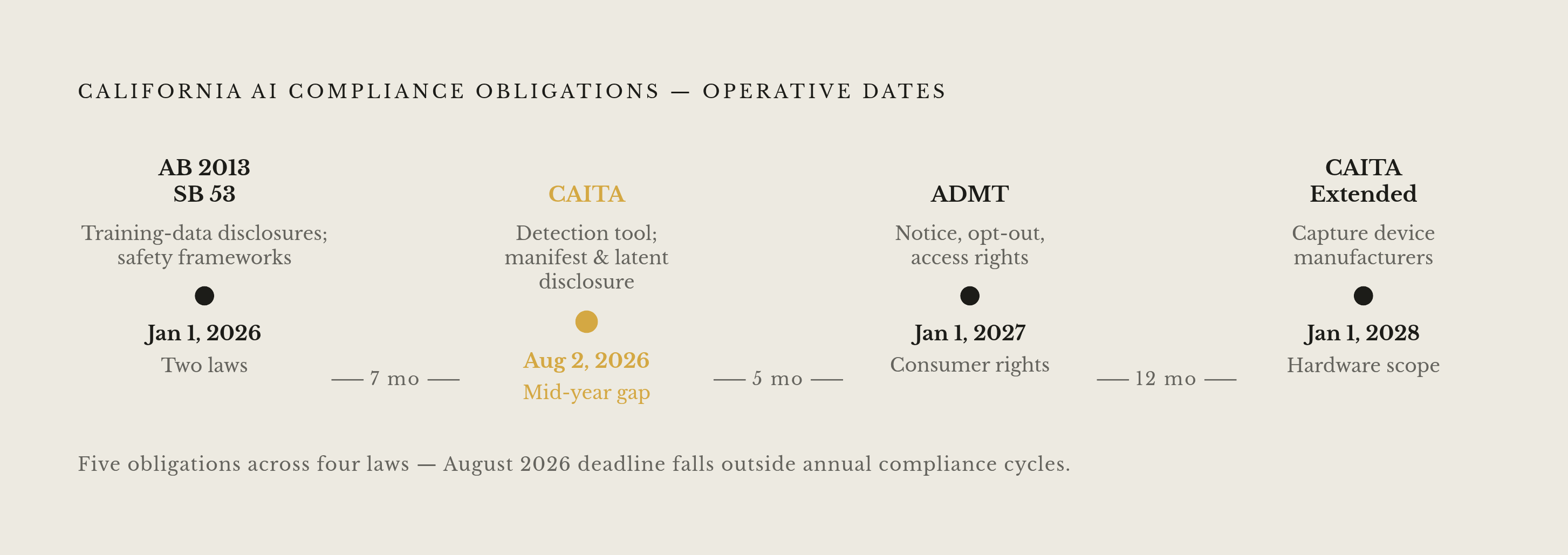
The calendar begins with January 1, 2026, but that date does not activate every obligation in the same way. AB 2013’s website disclosures and SB 53’s frontier-model requirements take effect then. AB 489 also takes effect for healthcare systems and marketing. The ADMT regulations become effective on that date, while their notice, opt-out, and access compliance deadline is January 1, 2027.
August 2, 2026, marks CAITA’s covered-provider obligations. By that date, the free detection tool must be live, the manifest disclosure option available, and latent disclosures embedded in generated image, video, and audio content. Delay creates per-day penalty exposure. Meeting this deadline requires tools for content-generation and provenance as well as changes to notices. It therefore belongs on the engineering and product calendar as well as the legal calendar.
January 1, 2027, brings ADMT consumer-rights compliance for all covered businesses, with new uses initiated on or after that date required to comply from the start. CAITA obligations also apply to large online platforms and generative AI hosting platforms that distribute model weights or source code. Organizations that distribute open-weight models or run large content platforms should build what they need to meet that deadline. January 1, 2028, then extends CAITA obligations to capture device manufacturers producing devices with built-in cameras, microphones, or voice recorders for sale in California.
Ownership must span privacy, AI, product, engineering, legal, and enterprise risk because the obligations cross those boundaries. A calendar assigning each requirement exclusively to one function will miss the interactions. Pending SB 1000 adds a further planning condition. If enacted, it would eliminate CAITA’s one-million-user threshold and bring any publicly accessible generative AI system within scope regardless of size. Smaller organizations should monitor its progress and treat that expansion as a planning assumption, building the operational infrastructure before the amendment resolves rather than waiting for the threshold buffer to disappear.
Methodology & sources
- New California AI Disclosure Rules Become Operative
Provided details on CAITA's operative date, per-day penalty amounts, and covered-provider obligations including the free detection tool and latent disclosure requirements.
- New California AI Laws Are Here: Is Your Business Ready?
Supplied background on the suite of California AI laws including AB 2013, SB 53, AB 489, and ADMT regulations, covering their scope, effective dates, and compliance requirements.
- Newest Slate of AI Laws Keeps California at the Forefront of US Regulation
Informed the article's framing of California's overlapping AI regulatory layers and the developer-deployer distinctions across CAITA, AB 2013, SB 53, and the ADMT regulations.