US Federal AI Executive Orders and Their Enterprise Compliance Implications
Agentic AI deployment now requires provable authorization and immutable audit trails.

- Written by
- Mirela Vanthorpe
- Published
- November 3, 2026
- Reading time
- 8 min read
- Sources cited
- 8 sources ↓
What this covers
The December 2025 and June 2026 federal AI executive orders create a layered enterprise compliance environment. Their most consequential implication is that agentic AI deployment is a legal design problem. The June order’s criminal enforcement priority makes provable authorization, deterministic allowlists, and immutable audit trails production requirements.
The two federal AI executive orders and what they actually do
President Trump signed “Ensuring a National Policy Framework for Artificial Intelligence” on December 11, 2025. Its central aim is to challenge state-level AI regulation and advance federal preemption. That distinction limits what businesses can infer from it. A policy seeking to displace state regulation does not itself remove the obligations that state law creates.
President Trump signed “Promoting Advanced Artificial Intelligence Innovation and Security” on June 2, 2026. It establishes cybersecurity mandates and a voluntary framework for frontier model deployment while expressly avoiding mandatory licensing or permitting requirements for AI models. The orders therefore work in sequence, with the December order contesting state regulatory authority and the June order showing how the administration intends to exercise federal authority. The operative mechanisms are cybersecurity coordination, criminal enforcement, and public-private collaboration. Enterprise compliance analysis must begin with those mechanisms, rather than prescriptive rules that neither order establishes.
What the December 2025 order does to state AI law — and what it cannot do
The December order creates mechanisms for challenging state AI laws, but it does not invalidate them. Enterprises operating across states remain subject to existing state obligations until courts or Congress act. The distinction has immediate consequences for compliance planning. A federal objection to a state requirement is not a basis for treating that requirement as unenforceable.
The order directs the Attorney General to establish an AI Litigation Task Force to challenge state AI laws inconsistent with federal policy. It also directs the Secretary of Commerce to identify laws that “obstruct, hinder, or otherwise contravene” national AI policy and provides for restrictions on federal funding to states with laws deemed obstructive. Separately, the order calls for legislative proposals establishing a uniform federal framework, with explicit carve-outs for child safety, state government AI procurement, and AI compute and data center infrastructure. Such legislation could eventually simplify compliance across states, but that outcome remains speculative.
State enforcement also extends beyond AI-specific legislation. A coalition of 42 state attorneys general wrote to major AI companies in December 2025 demanding chatbot safeguards for vulnerable users and warning of enforcement under existing consumer protection and criminal laws. State attorneys general still have broad powers over unfair and deceptive acts or practices, and enterprises also face AI governance requirements from their customer contracts, cyber insurance terms, and institutional investors. The current environment is therefore more layered than the order’s deregulatory framing suggests.
What the June 2026 order actually requires and who it directly binds
The June order moves from the federal-state dispute to operational cybersecurity requirements. It directs CISA to issue Binding Operational Directives by July 2, 2026, prioritizing the defense of civilian federal systems and expanding AI-enabled defensive tools. Federal agencies are the immediate subjects of these directives. Federal IT and cyber contractors delivering AI to the government also face obligations through the government systems and services they support, rather than through a general licensing regime for commercial AI.
The order also requires Treasury, in consultation with the National Cyber Director, NSA, and CISA, to establish a voluntary AI Cybersecurity Clearinghouse by July 2, 2026. The White House launched the “Gold Eagle” clearinghouse platform on July 14, 2026. The framework coordinates AI-assisted vulnerability scanning, validates findings, and coordinates and prioritizes patch remediation, bringing participating critical infrastructure operators into the federal cybersecurity effort without making participation a universal enterprise mandate.
A separate August 1, 2026 deadline requires NSA to finalize a classified benchmarking process for designating “covered frontier models” and establish a voluntary pre-release federal access framework for trusted partners. Enterprise buyers may procure tools shaped by benchmarks and clearinghouse standards even when no directive binds those buyers directly. Buyers may also come to expect developers to meet classified benchmarking criteria and have trusted-partner status, even though developers cannot see the classified criteria themselves. The voluntary label therefore does not make these mechanisms inconsequential, especially for companies building or buying agents that access third-party systems.
Why Section 4 of the June order is the most consequential provision for enterprise AI builders
Section 4 directs the Attorney General to prioritize enforcement of the Computer Fraud and Abuse Act, 18 U.S.C. § 1030, and wire fraud and identity fraud statutes against illegal AI-enabled computer access and related criminal activity. It targets those using AI to access or damage computers without authorization, as well as those using AI during illegal access to further another crime. This is an enforcement priority under existing law. It places agents’ behavior squarely within the federal enforcement agenda.
The CFAA prohibits intentionally accessing a protected computer without authorization or exceeding authorized access. For enterprise builders, the consequential question is whether an agent’s permitted actions correspond to access the enterprise can substantiate. The Amazon/Perplexity ruling established that a user’s consent to an agent’s actions does not constitute authorization from the platform being accessed. An enterprise must therefore distinguish the customer’s instruction from the third-party platform’s authorization before treating an autonomous action as permitted.
The hiQ Labs v. LinkedIn distinction supports the defensibility of scraping public, non-personal data without bypassing technical barriers, while credential use, disregarding robots.txt, and bypassing barriers such as a CAPTCHA raise authorization concerns. These are not interchangeable access conditions. Section 4 also covers crimes that later use data gained through illegal AI-enabled access, so the legal review must look at what happens after the data is collected. The design implication is immediate, because the agent’s access behavior and the evidence supporting its authorization must be defensible under existing law.
The three design requirements that Section 4 makes non-negotiable for agentic systems
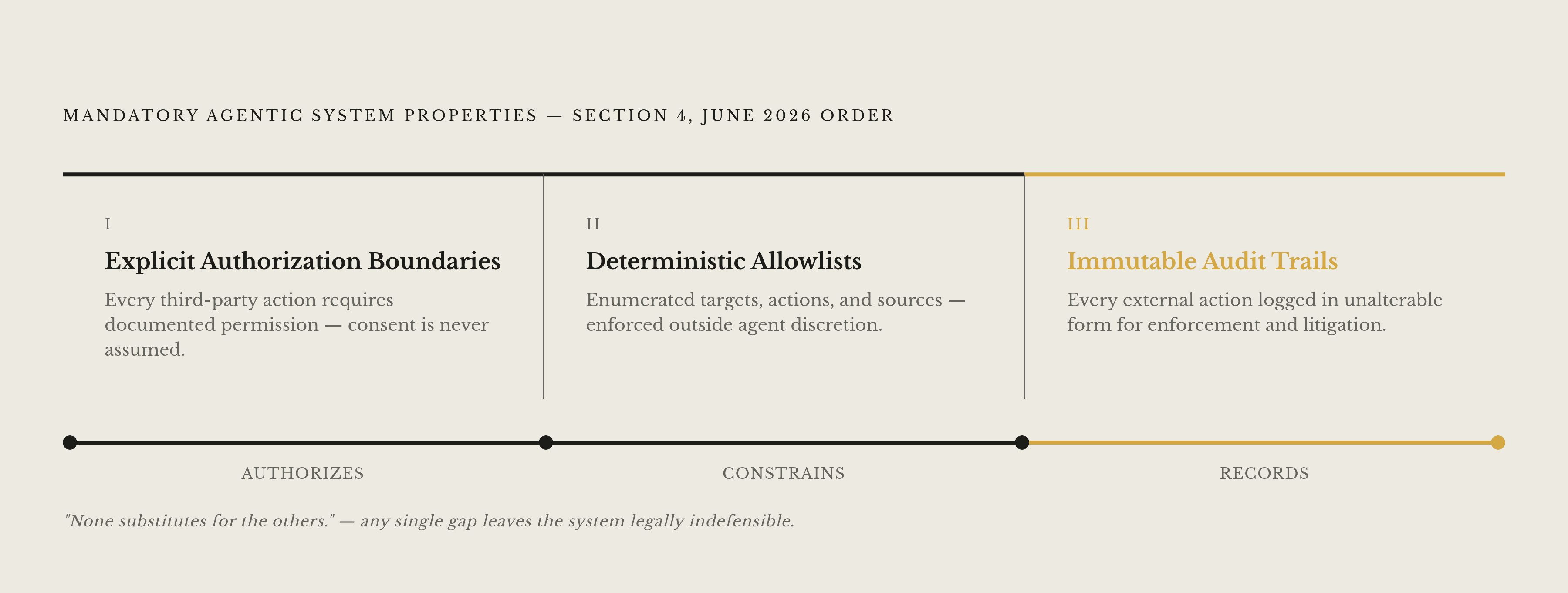
The engineering response requires three interdependent properties, namely explicit authorization boundaries, deterministic allowlists, and immutable audit trails. These are design requirements for provable authorization. Authorization boundaries establish what access is permitted, allowlists constrain what the agent can attempt, and audit trails preserve evidence of what it actually did. None substitutes for the others.
Explicit authorization boundaries require every action against a third-party system to rest on documented permission rather than assumptions about user consent or terms of service. For agents that autonomously browse, scrape, or execute API calls, legal and engineering teams must therefore re-examine authorization documentation, terms-of-service flow-through, and customer indemnification positions together. The enterprise needs both contract language that establishes permission and a technical boundary that limits what the agent can do.
Deterministic allowlists constrain agents to enumerated targets, actions, and data sources instead of open-ended capabilities that let the agent decide what is accessible. The constraint must exist outside the agent’s discretion. An allowlist that the agent can modify does not establish a provable boundary, nor does an application-layer policy without underlying enforcement. This makes the permitted scope of action an architectural decision rather than a runtime judgment entrusted to the model.
Immutable audit trails complete the evidence needed to establish what happened. Every action against an external system must be logged in a form that cannot be altered after the fact, because enforcement and litigation turn on actual conduct. Buyers, insurers, and institutional investors increasingly require documented governance of agent actions independently of regulatory mandates, giving the same evidence a procurement role. Rapidly shipped, “vibe-coded” agents without these properties expose a design gap that a post-launch policy document cannot close.
Why most enterprises are not operationally ready to meet this standard at scale
The principal barrier to these architectural properties is operational. Many enterprises run agent pilots, but few have successfully put agents into production at scale. A pilot does not establish operational readiness. Organizations need evaluation infrastructure, production monitoring, and people whose job is to oversee agents so they can govern them consistently in live workflows. Those structures give documented permissions and technical constraints the day-to-day support they need to stay reliable.
The organizations that have bridged the pilot-to-production gap share a dedicated AI operations function distinct from both IT and the business unit. That function is in charge of evaluation frameworks, production monitoring, and incident response. Diffused responsibility has not produced the same result. This is a structural distinction, because authorization, evidence, and response cannot be governed reliably when ownership is divided without a dedicated function. Healthcare faces the steepest readiness gap, as regulatory complexity and clinical risk aversion compound the organizational barriers present elsewhere.
The administration’s view that existing federal law can deal with AI harms makes it more urgent for enterprises to be ready. Enterprises have fewer clear instructions on which security measures to put in place, while criminal enforcement gets more priority. Waiting for mandatory standards is therefore an exposure strategy. The absence of a detailed federal AI rulebook does not suspend existing access restrictions or private governance obligations. The practical response is an operational readiness assessment before deployment, when gaps can still shape the system’s design and be addressed before production.
How a pre-deployment AI operations audit addresses the compliance requirements the orders create
A pre-deployment AI operations audit must assess six domains, which are business case, data, security, governance, operations, and measurement. A gap in any one can leave a system non-compliant, unmeasurable, or both. The domains must be assessed together. A business case still needs permission to access data, security controls need someone in charge of governance, and monitoring needs a basis for comparison to show improvement. The assessment connects the intended operational outcome to the conditions under which the agent may pursue it.
Checking the condition of the data offers the most value at the start, because process data must be consistent and documented before teams can set reliable authorization boundaries or make sense of audit trails. An immutable record is not automatically intelligible evidence. If the underlying data is inconsistent, preserving it does not resolve uncertainty about what an action meant or whether it fell within the authorized workflow. The audit must therefore address data condition before treating the existence of logs as proof that the system is defensible.
Measurement infrastructure must also precede deployment. The absence of a pre-deployment baseline is the most common reason AI ROI claims fail scrutiny, and authorization assessment requires a comparable foundation for distinguishing permitted behavior from actual behavior. Adoption metrics cannot answer either question adequately. Operational measurement must instead address cycle time, error rates, and authorization exceptions, while ROI models account for time saved, cost reduction, quality improvement, revenue impact, and risk reduction. This gives CFOs and audit committees a broader basis for judging whether deployment is producing value within acceptable boundaries.
Automotive deployments use agents for customer support, dealership matching, location-based routing, and test-drive scheduling, demonstrating how deterministic workflows can replace open-ended autonomy in operational use cases. Healthcare administrative deployments extend that pattern to patient intake, clinical trial data aggregation, and prior authorization routing when governance is built in from the start. Enterprises that put authorization boundaries, deterministic allowlists, and immutable audit trails in place before launch are in a better position to get through procurement faster and lower their risk under the June order’s enforcement priority.
Methodology & sources
- White House Issues Executive Order to Establish Uniform National AI Standards
Provided background on the December 2025 executive order's aim to establish uniform national AI standards and challenge state-level regulation.
- December 2025 AI Executive Order: Impact on Data Security and Compliance
Informed the article's treatment of the December 2025 order's data security and compliance implications for enterprises.
- AI Heats Up: New Executive Order on Promoting Advanced Artificial Intelligence Innovation and Security
Covered the June 2026 executive order's cybersecurity mandates and public-private cooperation framework discussed in the article.
- New AI Executive Order Calls for Frontier Model Security, Early Government Access and AI-Enabled Cyber Defense
Detailed the June 2026 order's frontier model security provisions, CISA directives, and voluntary clearinghouse framework referenced in the article.
- Promoting Advanced Artificial Intelligence Innovation and Security
Primary source for the June 2026 executive order's requirements, including Section 4 enforcement priorities and the AI Cybersecurity Clearinghouse.
- Trump’s AI Cybersecurity Order: A Voluntary Framework with Mandatory Implications
Supported the article's analysis that the voluntary clearinghouse framework carries mandatory implications for enterprises building or buying AI agents.
- Agentic AI Enterprise Adoption 2026: 72% Production Proven
Provided data on the enterprise gap between agentic AI pilots and production deployment at scale.
- Section 4 AI Agent Governance: Federal Enforcement Readiness Now
Informed the article's analysis of Section 4 governance requirements for agentic AI systems, including authorization boundaries and audit trails.