Role-Based Access Controls for AI Agents in Enterprise Systems
Agents need bounded identities and layered controls to own workflows.

- Written by
- Priya Subramaniam
- Published
- November 28, 2026
- Reading time
- 9 min read
- Sources cited
- 2 sources ↓
What this covers
- Why RBAC is not a security add-on but the foundational layer that decides whether an AI agent can own a workflow
- How AI agents violate every assumption that human IAM was built on
- What correctly designed agent identity looks like before any role is assigned
- The three-model toolkit for agent access control and when each one applies
Role-based access control for AI agents is an architectural requirement. An agent can own an enterprise workflow only when its identity, permissions, data access, and actions remain bounded and auditable throughout execution. That requires more than assigning a role. It requires controls designed for software that acts autonomously, delegates work, and makes repeated access requests.
Why RBAC is not a security add-on but the foundational layer that decides whether an AI agent can own a workflow
Production trust depends on explicit permission boundaries. An agent that completes a task successfully has demonstrated capability, but not that it can operate within the limits of its authority. It may reach the data it needs through credentials that also expose information it must never see. Without deliberate scoping, useful access and excessive access become indistinguishable.
RBAC draws the boundary between those two sets. For agents, that boundary depends on verifiable identities, defined actions and conditions, runtime enforcement, and an auditable record of execution. Least privilege, token scoping, and role assignment therefore need to be part of workflow design before the agent takes on production work.
GDPR, HIPAA, and SOC 2 make access controls relevant to systems handling enterprise data, including restrictions based on role and least privilege. But a compliance review cannot supply boundaries that the architecture lacks. The workflow itself must distinguish permitted behavior from behavior that happens to be technically possible.
How AI agents violate every assumption that human IAM was built on
Traditional identity and access management assumes a human at a keyboard, with one identity, one session, bounded working hours, and human-speed actions. Agents break that operating model in several ways. They authenticate machine-to-machine using client credentials, signed JWTs, or API keys in place of browser sessions. A single pipeline can also spawn dozens of parallel instances, each presenting a distinct access-scoping problem.
SSOJet’s framework identifies non-interactive operation, ephemeral and parallel execution, delegated authority, and composability as the defining differences. Delegation ties an agent’s authority to a human or organization whose permissions may change. Composability adds another complication because agents can spawn sub-agents. Neither relationship fits neatly into a session model built around one person’s access.
A coarse data-pipeline role may expose every source within its remit when an agent needs only one source for one tenant. A session-level authorization decision also fails to distinguish a legitimate read from an unauthorized write later in the workflow. OWASP’s LLM Top 10 (2025) ranks Prompt Injection first among risks for LLM applications, making excessive permissions particularly consequential when attacker-controlled input redirects an agent’s actions.
What correctly designed agent identity looks like before any role is assigned
An agent needs a defined identity before a role assignment can have a precise meaning. SSOJet’s identity framework establishes four attributes, which are a stable agent ID, an owner, an explicit capability set, and a trust level. Each answers a different authorization question. Together, they establish who is acting, whose authority supports the action, what the agent may do, and how much the system accepts claims made by or about it.
The agent ID identifies the agent class durably. It is not a session token, shared API key, or service account inherited from a human. The owner identifies the human or organization whose permissions the agent borrows, so revocation can cascade to the agent. The capability set declares permitted actions rather than leaving them implicit in a broad role, while the trust level constrains how instructions from other agents are treated.
NIST guidance treats agents as first-class principals with their own roles, credentials, and review cycles. Shared credentials defeat that distinction by obscuring which agent acted. The prerequisite is therefore a current inventory covering production agents, developer plugins, and legacy proof-of-concept accounts, with reachable data sources, individual identities, retrievable logs, named owners, and scheduled reviews. An unlisted agent remains outside the controls built above that inventory.
The three-model toolkit for agent access control and when each one applies
RBAC, attribute-based access control, and fine-grained authorization perform different jobs. None substitutes for the other two in dynamic, multi-tenant agent workflows. RBAC groups permissions by function and establishes the outer boundary. A customer-support role should not have access to financial ERP data, and a legal review role should not be allowed to write to customer records.
Delight.ai illustrates how broad and specific permissions can compose. Its Role sets what can be accessed across the system, while its Permission Set sets which actions are allowed with particular agents and features. That distinction makes roles more precise, but context still changes what an otherwise authorized agent should be able to do. The role an agent belongs to cannot cover every condition tied to a tenant, task, or data-classification.
ABAC adds those conditions to each request while keeping the role structure in place. Tenant ID, time of day, task type, data classification, and device can change the effective permissions of the same agent class. This is especially useful when agents serve multiple tenants or operate across regulatory jurisdictions.
Google’s Zanzibar paper introduced a relation-tuple model for authorization over individual objects and relationships. Fine-grained authorization applies that model where permissions must distinguish particular customers’ data or support object-level decision traces. OpenFGA and other authorization systems provide concrete implementations of this approach. In combination, RBAC establishes the structural boundary, ABAC refines it by context, and FGA enforces object-level restrictions for sensitive operations.
How the context graph layer enforces what an authorized agent is actually allowed to see
Authorization to invoke an agent and authorization to retrieve every item available to it are separate enforcement decisions. Atlan’s context-layer model distinguishes authenticated invocation from role-based retrieval, which governs the slice of the data graph visible after execution begins. Passing the first check cannot substitute for the second.
The retrieval boundary has three layers. Asset-level policy first restricts the data sources, schemas, and domains a role can query. Row-level policy then filters records within an accessible dataset, such as by attaching a region predicate to a regional manager’s revenue query before execution. Column-level policy masks fields such as compensation, account numbers, and PHI even in rows the agent is otherwise allowed to see.
Excluding entire domains first avoids applying fine-grained rules across assets the role should never reach. Enforcing policy at the query layer also means the same agent and prompt can produce appropriately different answers for a data engineer, compliance officer, and executive assistant. The same policy applies to every agent querying the graph.
Access-policy review and context drift detection address the gap between configured permissions and current responsibilities.
How multi-agent delegation creates privilege escalation risk and how scope downscoping prevents it
Delegation can widen effective access without changing any role definitions. Agent A may legitimately read financial records, then spawn Agent B for a sub-task that requires no financial access. If B gets A’s full token, it gets authority it does not need for its task. The delegation has created excess privilege even though B has not exceeded its parent’s permissions.
SSOJet’s framework requires explicit scope downscoping at that boundary. A child receives a token derived from the parent’s authority but narrowed to the permissions needed for its sub-task. Its effective permissions must remain a subset of the parent’s, regardless of instructions received at runtime.
The identity’s trust level provides a separate constraint. A child should not treat every instruction from an orchestrator as though it came from a human principal with unrestricted authority. Adversarial content passed down the chain makes prompt injection both an authorization problem and a prompt-hygiene problem. Deny-by-default tool allowlists enforce the resulting boundary by blocking tools outside the agent’s declared permissions, whatever its LLM completion requests.
What runtime enforcement and audit trails must look like for agents operating in regulated verticals
Healthcare and legal workflows make the retrieval boundary especially concrete. An agent may be allowed to read a record but barred from seeing particular PHI fields. A legal review agent may retrieve privileged communications without being authorized to export them. The audit trail must therefore show what was retrieved.
Permissions must be evaluated at every tool call. Read access does not imply write access later in the same session, and sensitive access should expire with the task. Revocation must also follow delegated authority immediately. When an owner loses access, agents acting on that owner’s behalf must lose it then, without waiting for the next review.
Every action needs an immutable, retrievable decision trace. That trace records the agent, tool, data touched, policy permitting the action, and owner on whose behalf it acted. A mutable log cannot serve as a dependable compliance artifact, while a log that reviewers cannot query is operationally inadequate. Enforcement and evidence must therefore be designed together.
Automotive dealership networks also need tenant-isolation. Agents handling support, routing, or inventory analysis need tenant-scoped identities so that shared systems do not expose another dealership’s customer or inventory data.
How to implement RBAC for agents in practice — the seven operational steps
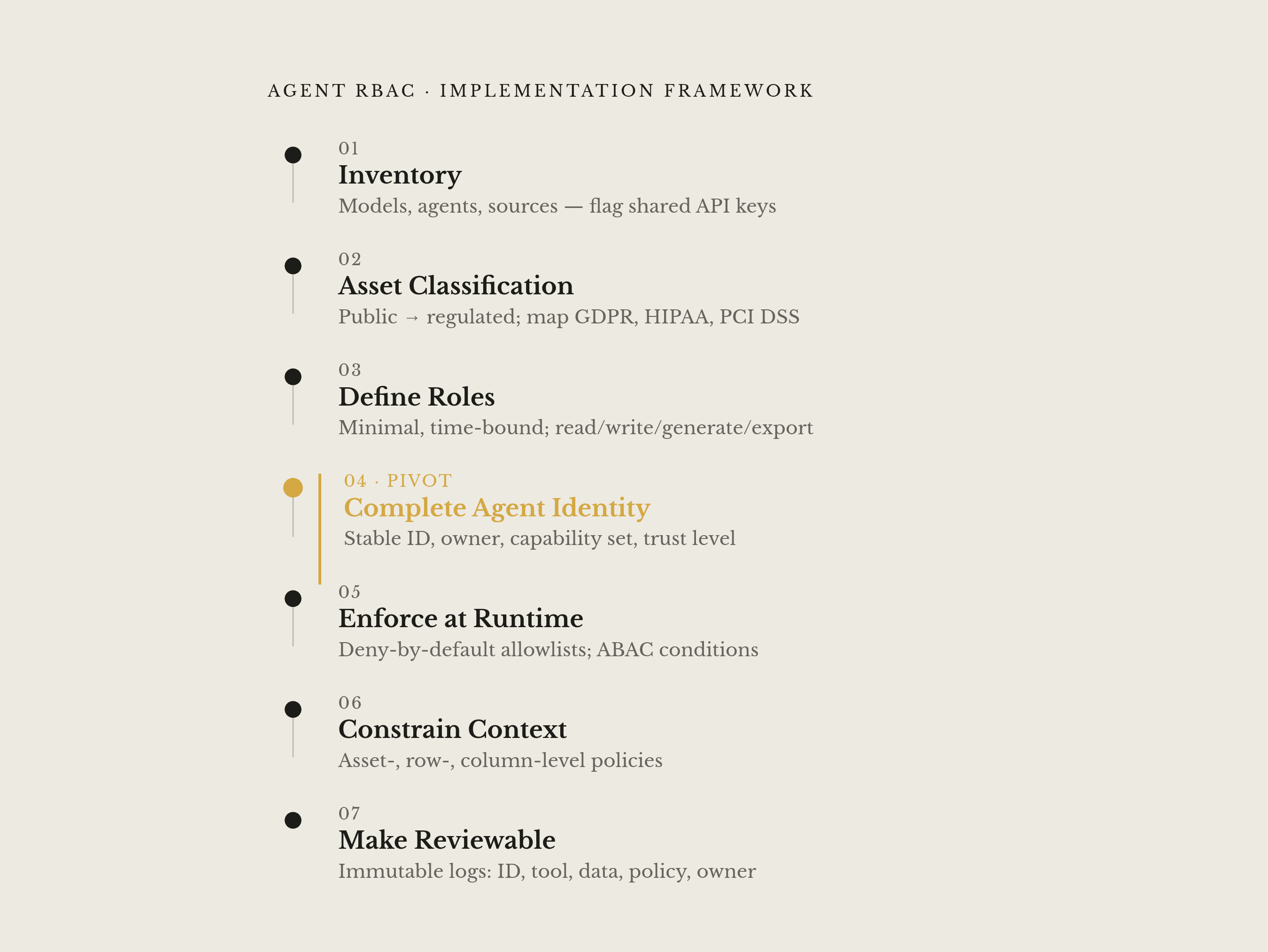
CData’s implementation framework provides the basis for an ordered operational sequence. For practitioners, the starting point is one high-value agent, with the full sequence applied and audit retrievability verified before expansion. The first step is inventory. Record each model, agent, copilot, and reachable data source, including unofficial agents, developer plugins, and legacy accounts, with its function and authentication method. Flag shared API keys for remediation.
The second step is asset classification. Tag sources as public, internal, confidential, or regulated, and record exposure to GDPR, HIPAA, or PCI DSS where applicable. Map those classifications to default agent access and regulatory constraints. This matrix gives role design an explicit basis rather than leaving access decisions to assumptions about the data.
The third step is defining minimal, time-bound roles. Use job function to establish a small role set, then map read, write, generate, and export permissions against the classified assets. Apply the role structure to both humans and agents without treating their identities as interchangeable. Replace shared credentials with individual identities and scoped roles, with sensitive grants lasting only for the task.
The fourth step is to finish defining the agent identity. Assign the stable agent ID, owner, declared capability set, and trust level before activating role assignments. Configure automatic revocation cascades from the owner. Role design can precede this assignment, but effective authorization depends on a fully defined principal.
The fifth step is to enforce policy when tools run. Configure deny-by-default tool allowlists and evaluate each call independently. Where role boundaries do not cover what is needed, add ABAC conditions such as tenant ID, data classification, and task type.
The sixth step constrains retrieved context. Use asset-level, row-level, and column-level policies to control what can be queried at the data-query layer. This closes the gap between permission to run and permission to see. Shared query-layer enforcement also avoids reproducing the same retrieval rules separately for every agent.
The seventh step makes enforcement reviewable over time. Log each action with the agent ID, tool, data, permitting policy, and owner, and establish immutable retention. Name the owners who will review role assignments at regular intervals. Before expanding the implementation, verify that reviewers can retrieve the evidence needed to reconstruct an agent’s actions.
Why governance built after deployment costs more and delivers less than governance built in from the start
Retrofitting governance forces teams to revisit credentials, role boundaries, retrieval paths, and logging after workflows already depend on them. Informal, team-level trust may support a pilot, but it does not provide the controls needed at scale. The gap is whether the surrounding system can bound, explain, and review the agent’s actions.
Workflows with clear limits, such as customer-support triage, code review, data extraction, and internal research, offer a clearer path into production. Their scope can be expressed through permissions, role-enforced data access, and logged action chains. For enterprises checking whether they are ready, an AI Operations Audit offers a structured way to check permission architecture, governance readiness, and whether the audit trail is complete before deployment.
Cloudera’s CPO Leo Brunnick framed the production gate as knowing who the user is and what that user may see, allowing organizations to “actually put stuff into production that doesn't blow up on them”. Eigenomic, an end-to-end AI workflow agency that puts agents into production within weeks, treats access scoping as part of agent design from the start. That approach makes permission boundaries a prerequisite for workflow ownership rather than an unresolved dependency discovered in security review.
Methodology & sources
- Securing AI Agents: Implementing Role-Based Access Control for Industrial Applications
Supplied the approach of applying role-based access control to AI agents in industrial settings, including scoped roles and runtime enforcement.
- Towards Elastic Least Privilege for Agent Planning
Informed the point that a child agent's permissions should be narrowed to its sub-task and stay within its parent's authority.