Data Minimization Principles Applied to Enterprise AI Agent Pipelines
A layer-by-layer framework for bounding what AI agents can see, keep, and do.

- Written by
- Tomas Řeháček
- Published
- November 27, 2026
- Reading time
- 9 min read
- Sources cited
- 3 sources ↓
What this covers
- Why enterprise AI agents structurally resist data minimization
- What GDPR Article 25 and least-privilege access actually require at each pipeline layer
- The RAG retrieval boundary problem and why semantic indexing changes the control surface
- How multi-step memory accumulation creates a second, distinct minimization failure
Enterprise AI agent pipelines need data minimization at every layer. Retrieval, persistent memory, inference, and execution create different forms of exposure. A production framework must bound each one and make those boundaries enforceable through governance, so that an agent’s access remains tied to its business purpose.
Why enterprise AI agents structurally resist data minimization
Agentic pipelines are designed around broad context, iterative retrieval, and persistent memory. Data minimization requires a narrower posture, with information limited to a defined purpose and retained only as needed. These design goals pull in opposite directions. An autonomous agent may discover its next information need during execution, while the enterprise must constrain its access before that need is known.
Three failure modes explain where that conflict appears. A natural-language task does not precisely define the records needed to complete it. Model context contamination occurs when retrieved information enters reasoning and it becomes hard to separate its influence from the rest. Tool over-privilege makes both problems worse when unclear requirements lead to permissions that go beyond what the task needs.
Storage controls alone cannot contain this exposure. Traditional enterprise controls assume that data reaches a defined system where storage rules can govern it. Agents also expose data during inference, a layer that many enterprise security stacks cannot see. Parallax: Why AI Agents That Think Must Never Act identifies a related weakness in prompt-based protection, because safety instructions and adversarial data pass through the same computational mechanism without an architectural distinction.
What GDPR Article 25 and least-privilege access actually require at each pipeline layer
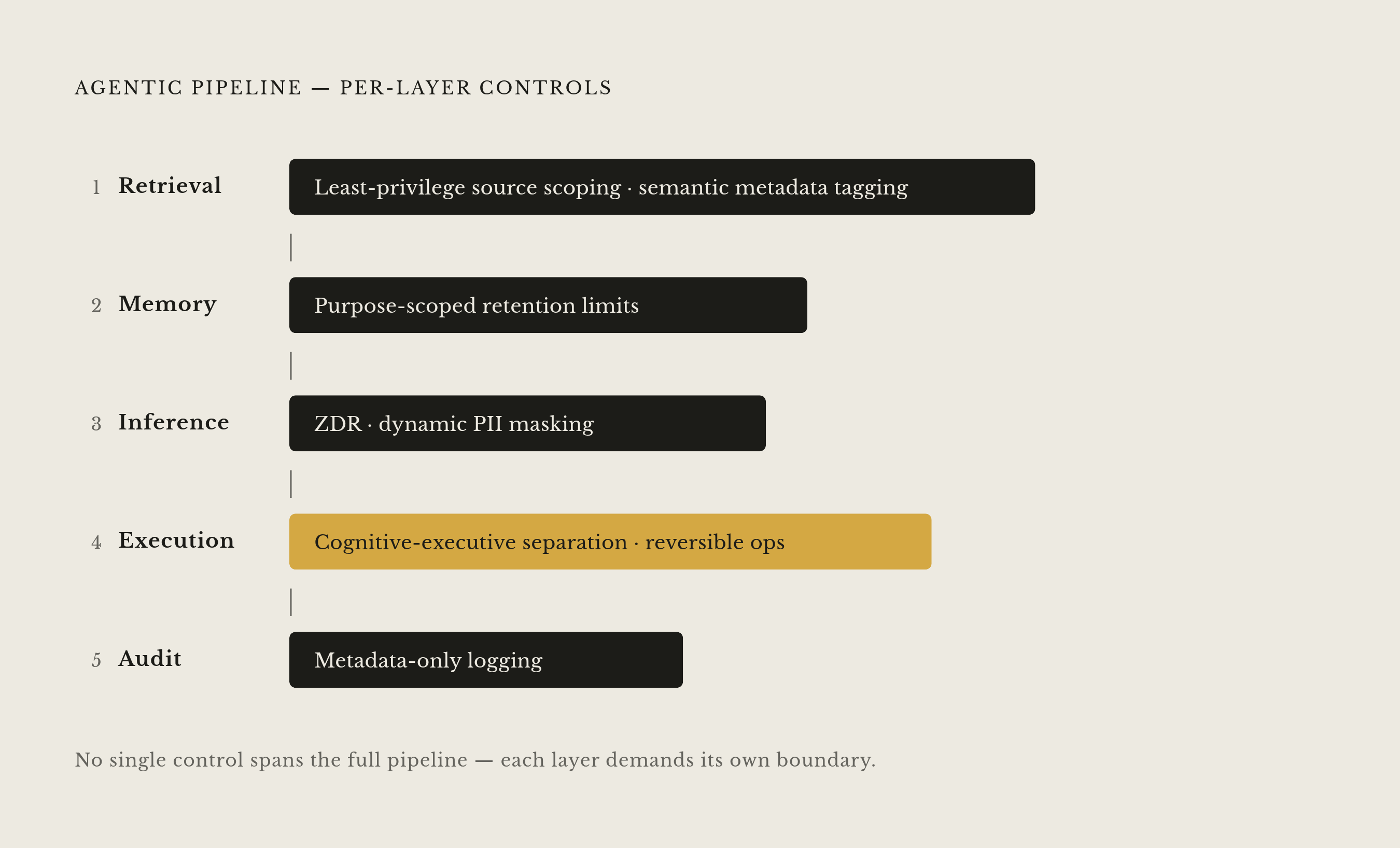
GDPR Article 25 requires data protection by design and by default. For an agentic pipeline, that obligation requires least privilege to limit which records the retrieval step can put into the prompt before they reach the model.
The same principle takes different forms downstream. Memory requires limits on persistence across steps and sessions, while inference requires boundaries on what reaches the provider and what the provider retains. At execution, the actions an agent is allowed to take must fit its purpose.
An audit needs enough evidence to reconstruct tool use, retrieval, and the basis for an action without creating another repository of sensitive content. A support agent processing billing disputes involving cardholder data brings PCI DSS into scope. A legal agent needs a different boundary because a provider that keeps privileged prompts and uses them for training may compromise attorney-client privilege.
The RAG retrieval boundary problem and why semantic indexing changes the control surface
Standard vector retrieval selects by similarity. A semantically relevant result can still be outside an agent’s business need, so similarity alone is not a sufficient access boundary. False positives are therefore more than an accuracy problem. They can expose sensitive information before the agent decides whether to use it.
Enterprise Representation Simplification (ERS): Reducing Representational Complexity for Enterprise AI proposes reducing unnecessary complexity before retrieval occurs. The ERS paper distinguishes better selection from a complex representation from simplifying the representation itself. Its Enterprise Representation Complexity measure covers four dimensions, which are Representation Objects, Interactions, Behaviors, and Supporting Sources. The paper also cites research on translating natural-language requests into database queries that supports a link between lower schema and reasoning complexity and more accurate reasoning. For RAG, a purpose-scoped representation similarly narrows the irrelevant information available for selection.
Semantic indexing addresses the remaining access problem. Metadata tags, ownership details, and usage restrictions let permission enforcement account for what content means, so controls can go beyond file names or locations. The automotive warranty triage case makes that boundary concrete, with retrieval grounded in approved internal sources. Lake Formation permissions on source tables do not automatically transfer to downstream vector indexes, so source authorization cannot be assumed to protect the retrieval layer.
How multi-step memory accumulation creates a second, distinct minimization failure
A correctly bounded retrieval does not justify indefinite reuse. Information needed for one step can become unnecessary in a later step, or inappropriate in another session. Retrieval governs what may enter now, while memory governs what may be kept for later use.
The Parallax paper describes memory poisoning that implants false instructions persisting across sessions. It also finds that agents with long conversation histories are more vulnerable because gradual context shifts can change the model’s effective constraint boundary. Uncontrolled persistence connects the security and minimization failures. When one agent’s output becomes another’s input, the exposure can extend through subsequent pipeline layers.
Purpose-scoped memory is the response to that persistence problem. A scheduling agent does not need full CRM access, a support agent does not need marketing data, and a lead qualification agent does not need payment details. A global memory store erases these distinctions by making information accumulated for one purpose available to another. Retention and minimization policies must therefore cover persistent agent contexts explicitly.
Zero Data Retention as an architectural response, not a policy promise
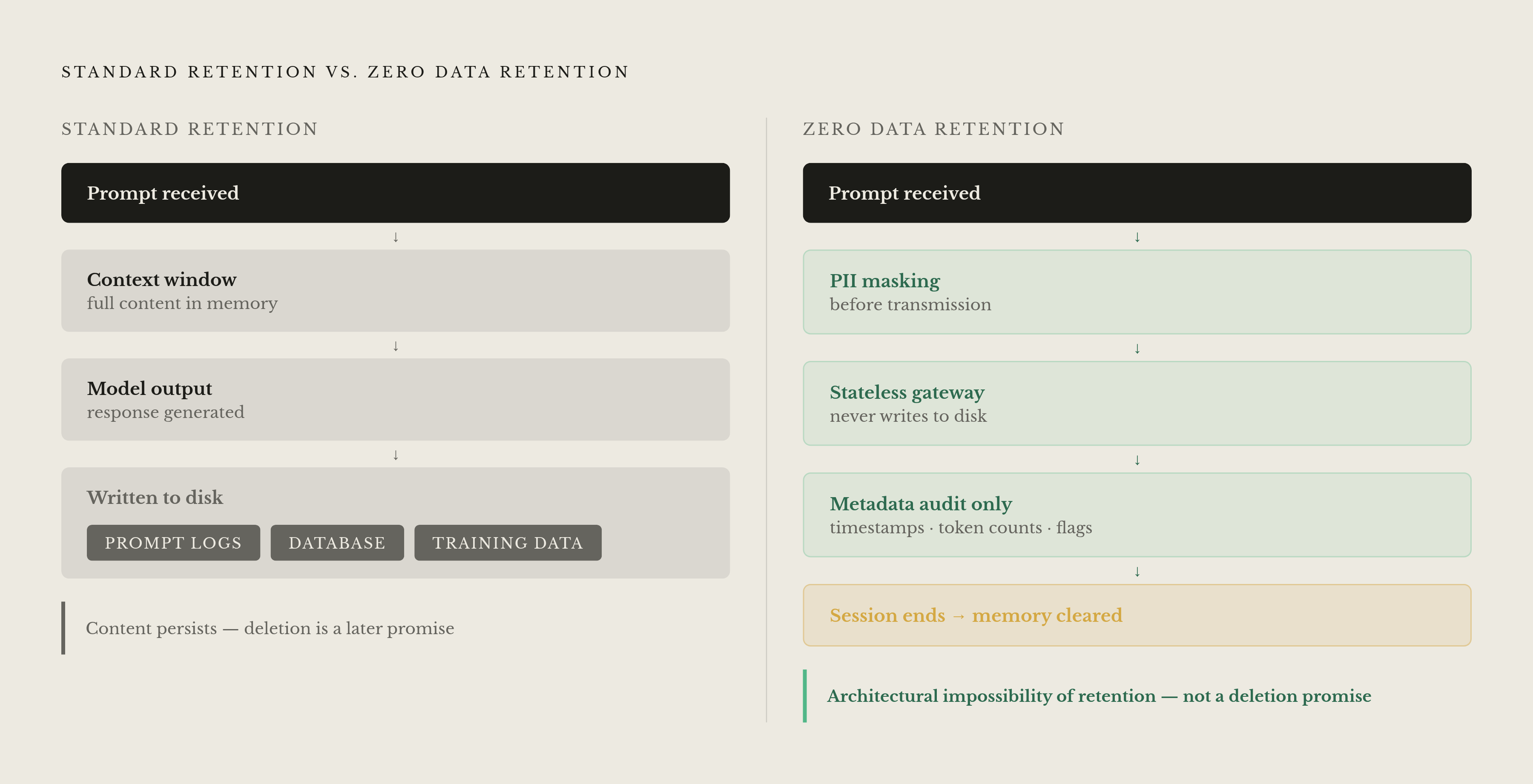
Zero Data Retention, or ZDR, sets a technical limit on what the provider can keep. Prompts, context windows, and outputs are processed in memory without being written to persistent logs, databases, or training datasets. When the session ends, that content is gone. A promise to delete stored information later is a different control from an architecture that cannot retain it.
Three mechanisms make that distinction operational. Dynamic PII masking removes identifiable information before transmission to the LLM. A stateless AI gateway intercepts requests, never writes them to disk, and enforces provider-side ZDR API options. Metadata-only audit logging records timestamps, token counts, policy outcomes, and anomaly flags without storing prompts or responses. This preserves decision provenance without requiring a content archive, although it is not the same as reproducing the full reasoning content.
ZDR needs explicit terms in the MSA or Data Processing Addendum, including audit rights, because a provider’s default terms do not guarantee it. A commitment not to train on data does not mean the provider will not retain it. ZDR is the strongest provider-side control in this framework, but it does not govern what an agent retrieves, retains locally, or does with information before transmission.
Why prompt-level guardrails fail as the primary safety boundary in agentic pipelines
Prompt instructions cannot substitute for an execution boundary. An agent that reasons over untrusted information and can directly act on its conclusions places both functions inside the same vulnerable path. Because trusted instructions and hostile content pass through the shared computational mechanism described earlier, stronger wording alone cannot reliably separate them.
The Parallax paper proposes Cognitive-Executive Separation as the architectural response. The reasoning system cannot carry out actions directly, and an independent, multi-tiered validator sits between reasoning and execution. This changes where authority resides in the pipeline. The model can propose an action without possessing the authority to carry it out unchecked.
Information Flow Control extends that separation to data use by propagating sensitivity labels through agent workflows. Tracking which data touched which reasoning step helps detect context-dependent threats and makes minimization relevant to both retrieval and action validation. Reversible Execution provides a fail-safe by saving the state before a destructive action so that rollback is possible when validation fails. Rollback does not replace prevention of unnecessary exposure. Its role is to bound the consequences of an execution failure.
Governance structures that make pipeline-layer controls operational across the enterprise
To make these controls operational, an enterprise needs an inventory that reaches beyond chat tools. Every agent should have a documented business purpose, owner, deployment environment, connected systems, data access, permitted actions, and risk classification. The inventory must include agents built in-house, agents from vendors, and agents embedded in SaaS platforms. Autonomous workflows and tool permissions belong in scope. Otherwise, the register describes visible interfaces while omitting the systems that can retrieve information and act on it.
Readiness also needs assessment by dimension. An organization may be ready for low-risk productivity AI without being ready for customer-impacting agents or regulated decision support. The governance model must preserve that distinction when setting deployment boundaries. Technical readiness in one area cannot stand in for missing controls in another.
SAP’s Human-AI Agent Interaction in a Business Context study identifies effective human-AI interaction patterns as important to value creation as agents enter core business processes. In practice, governance must specify where human approval is mandatory. The warranty triage case illustrates this division of authority through required human sign-off for escalation or supplier chargebacks.
What an AI Operations Audit covers for agentic pipeline data minimization
An AI Operations Audit turns these governance requirements into a pre-deployment assessment of evidence. Its first gating question is what data each agent can reach. An organization unable to answer that question is not ready for high-impact agents. The assessment must include agents embedded in SaaS platforms, because an incomplete inventory leaves part of the access boundary unexamined.
The audit should check whether there are data classification standards and whether each agent has a defined set of approved sources. It should examine whether retrieval access rules are documented and enforced, with data-loss controls active at that layer. Memory retention schedules must cover both static storage and persistent contexts. Prompt logging policy must also agree with the system’s ZDR commitments.
Sensitive-field masking must be checked before data is sent, and the MSA or data processing agreement must reflect the review of how the vendor uses data. Data-quality metrics should be tracked as part of readiness. These checks test whether the proposed boundaries work together and go beyond checking for separate policies.
Eigenomic’s AI Operations Audit is one option for organizing this assessment, and the enterprise AI agent builder sets retrieval-layer access controls and inference-layer boundaries during the initial build. That approach places data protection by design where Article 25 requires it, rather than treating protection as a post-deployment addition.
Applying the framework in practice — what minimization-compliant pipelines look like in automotive, legal, and healthcare
The automotive warranty triage agent uses both retrieval and execution controls as it works with repair orders, claim histories, and technical service bulletins. Approved internal sources define the information base, while IAM enforces least privilege. Human approval gates escalation and supplier chargebacks. Audit logs capture every retrieval item and decision, making retrieval and action traceable within the workflow. The expected outcomes are a meaningful reduction in manual handling time and faster issue detection in warranty and inspection scenarios.
Legal contract review puts more weight on what the provider keeps and what the agent’s task covers. Privileged content cannot be treated as ordinary reusable context, because retained prompts used for training may compromise privilege. ZDR is therefore a requirement in this design. The MSA must explicitly prohibit retention and training use, while the agent’s task is bounded to flagging exceptions that require legal expertise. This approach supports substantially more contract volume with the same team size and more consistent review that reduces legal risk.
Healthcare workflow agents apply clinical context minimization by retrieving only the problem list items, medication names, or appointment details required for the task. Failure behavior also needs a defined boundary. When source systems fail, downtime-safe design gives staff a clear way to do the work manually and clear guidance to follow. The BAA must cover both the underlying integrations and the agent layer itself, and provider-side ZDR remains part of the framework.
Across these settings, the critical boundary changes with the task, but no single control replaces the others. Bounded retrieval, scoped memory, provider-side ZDR, separated reasoning and execution, and documented governance serve different purposes. Together, they make production authority defensible. What appears to constrain an agent at design time becomes the set of operating properties that makes it trustworthy enough to use.
Methodology & sources
- Enterprise Representation Simplification (ERS): Reducing Representational Complexity for Enterprise AI
Supplied the Enterprise Representation Complexity measure and the argument for simplifying representations before retrieval.
- Parallax: Why AI Agents That Think Must Never Act
Provided the analysis of prompt-level safety weaknesses, memory poisoning, Cognitive-Executive Separation, Information Flow Control, and Reversible Execution.
- Human-AI Agent Interaction in a Business Context
Supported the point that human-AI interaction patterns matter for value creation as agents enter core business processes.