EU AI Act Conformity Assessment Process for Enterprise AI
Conformity assessment is a production-readiness test, with dates and routes.

- Written by
- Tomas Řeháček
- Published
- October 19, 2026
- Reading time
- 9 min read
- Sources cited
- 2 sources ↓
What this covers
- Why the EU AI Act conformity assessment is a production-readiness test, not a filing exercise
- Where the enforcement clock actually stands after the AI Omnibus revision
- Which enterprise AI systems actually fall into the high-risk category
- The two conformity assessment paths and what each demands operationally
The EU AI Act conformity assessment process tests whether enterprise AI is ready for production. Its demands for technical documentation, risk management, data governance and human oversight reach into how systems are built and operated. Enterprises that treat assessment as a deployment discipline are better positioned to demonstrate compliance and sustain performance in real use.
Why the EU AI Act conformity assessment is a production-readiness test, not a filing exercise
A conformity file cannot substitute for controls that do not exist. The assessment examines requirements across Articles 9–15, including risk management, data governance, technical documentation, record-keeping, transparency, human oversight, accuracy, robustness and cybersecurity. These are also the subjects of a rigorous pre-production engineering review. Treating them as legal formalities postpones the work until gaps become harder to resolve. Enterprises already doing rigorous deployment work therefore have a substantial foundation, though they still have to demonstrate conformity.
The Act scales obligations with a system’s assessed risk. It applies to organizations placing AI on the EU market or whose AI outputs affect EU users, regardless of where those organizations are headquartered. That makes assessment a global enterprise concern rather than a task reserved for European operations. The enterprise must be able to produce evidence that its system meets the requirements attached to its use.
Where the enforcement clock actually stands after the AI Omnibus revision
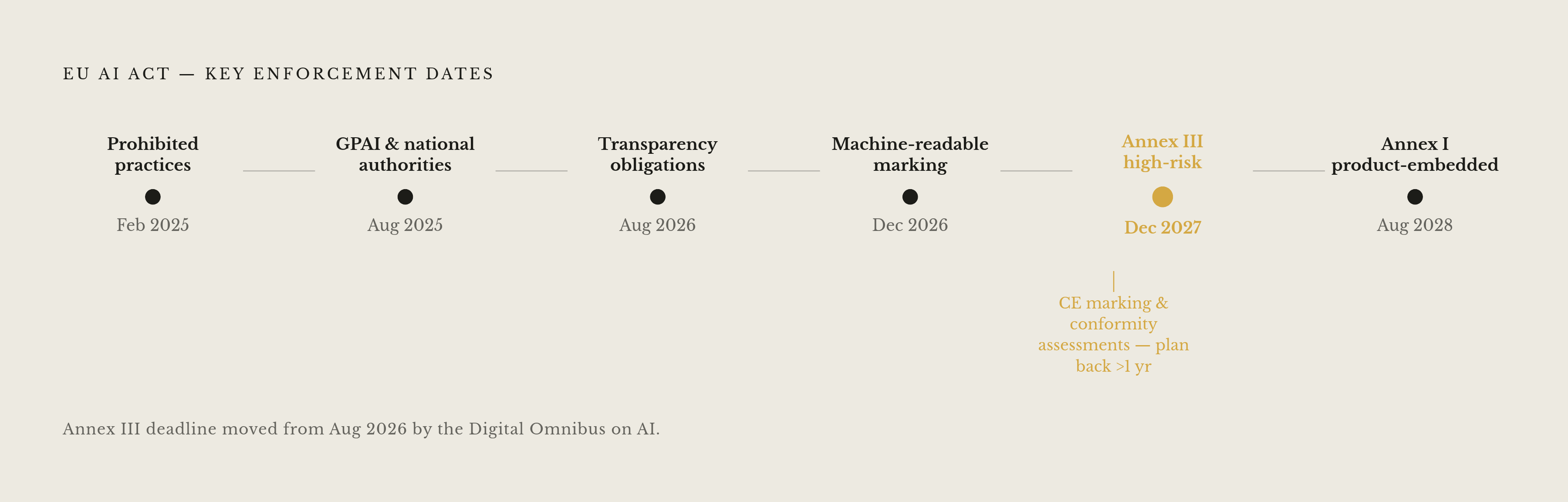
Prohibited practices became enforceable in February 2025. The obligations for General-purpose AI models took effect in August 2025, when national competent authorities also began their work. Article 50 transparency obligations, including AI-interaction disclosure and deepfake labelling, apply from August 2026 and were not deferred. Machine-readable marking under Article 50(2) also applies from that date for new systems, while generative AI systems placed on the market before 2 August 2026 have until 2 December 2026 to comply with that marking obligation.
Regulation (EU) 2026/1744, the Digital Omnibus on AI, entered into force on 27 July 2026. It moved the full Annex III high-risk requirements, including conformity assessments and CE marking, from 2 August 2026 to 2 December 2027. Annex I product-embedded high-risk systems have a deadline of 2 August 2028. The Cloud Security Alliance’s March 2026 research note found enterprise assessment programs still nascent before the original deadline. A complex conformity assessment, particularly one involving a notified body, can take well over a year, making lead time a material planning constraint.
Which enterprise AI systems actually fall into the high-risk category
Annex III covers eight sectors that include work commonly done in enterprises. Biometrics includes remote biometric identification, biometric categorisation inferring sensitive attributes, and emotion recognition by public authorities or in employment or education. Critical infrastructure includes AI safety components in road traffic, water, gas, electricity, heating and digital infrastructure. Education and vocational training includes admissions screening, student performance assessment and learner monitoring. Employment and worker management covers screening a CV, analysing an interview, deciding who gets a promotion, assigning tasks and monitoring performance.
Essential private and public services includes credit scoring, insurance risk and pricing, deciding who is eligible for benefits and emergency dispatch. Law enforcement includes profiling, risk assessment and the evaluation of evidence. Migration, asylum, and border control is another category. Administration of justice and democratic processes includes AI that helps judicial authorities with legal research or fact-finding, and AI used to influence elections, referenda or voting behaviour.
Classification therefore depends on what a system is meant to do, beyond how technically sophisticated it seems. High-risk obligations attach at design time, so late classification can force re-engineering under deadline pressure. Prudent practice is to treat a system that cannot clearly be ruled out as high-risk until a formal determination resolves its status.
The two conformity assessment paths and what each demands operationally
The assessment route depends on system type and its relationship to regulated products. Most Annex III systems can use internal self-assessment under Annex VI if they are not safety components in products already covered by EU product safety legislation. The provider systematically verifies compliance with Articles 9–15 without mandatory notified body involvement. The process culminates in an EU Declaration of Conformity and CE marking, followed by registration in the EU AI database. Internal responsibility does not reduce the evidence required.
Under the third-party route in Annex VII, a notified body audits the quality management system and reviews the technical file. It may ask for tests or access to training and testing data before it issues an EU technical documentation assessment certificate. That external review makes the schedule depend on the notified body too, so it is important to involve it early. For both routes, Article 11 and Annex IV require technical documentation before the system is placed on the market. Article 18 requires its retention for 10 years afterward, so the file is both a deployment prerequisite and a lasting obligation.
What technical documentation actually requires an enterprise to produce
Annex IV makes the technical file the spine of the conformity package. It requires a general description of the system and its intended purpose, design specifications and development methods, and algorithm architecture. It also calls for bias assessments, dataset protocols, risk assessment documentation and performance metrics. A post-market monitoring plan and the EU Declaration of Conformity complete the material described here. Together, these components connect the system’s purpose to the evidence supporting its use.
That connection is what a serious deployment review needs before go-live. The description establishes what the system is meant to do, while the architecture and development record explain how it reaches its outputs. Dataset protocols and bias assessments establish the basis for evaluating its data, and risk documentation identifies where it can fail. Performance metrics and the monitoring plan link how the system is evaluated before deployment to how it runs once live. Because this evidence must exist before market entry, documentation has to develop with the design.
How risk management and data governance under Articles 9 and 10 function as engineering disciplines
Article 9 requires a risk management system that is set up, put into practice, documented and kept up throughout the AI system’s lifecycle. It must identify and analyse known and reasonably foreseeable risks, evaluate risks arising from use, and implement mitigation measures. The obligation is therefore not satisfied by a single review before launch. As an engineering discipline, it ties identified failure modes to measures intended to control them.
Article 10 sets a similar quality gate for the data used in training, validation and testing. The data must be relevant, representative, free from errors and complete relative to the intended purpose. Providers must understand its origin, scope and characteristics, and examine it for possible biases. These requirements constrain development choices from the start by requiring well-catalogued, documented data of known provenance as a basis for judging data quality.
Human oversight under Article 14 and why it is the hardest requirement for autonomous AI agents
Article 14 places sharper demands on a production-ready system than on a controlled demonstration. For autonomous agents, oversight has to work while the system acts, triggers workflows, approves transactions or shapes what happens in the real world at machine speed. Meaningful intervention points must therefore be part of the design. A nominal control that no operator could realistically use at the speed of operation does not provide meaningful oversight.
Nannini, Smith, and Tiulkanov’s April 2026 legal analysis concluded that high-risk agentic AI systems with untraceable behavioural drift cannot currently satisfy the Act’s essential requirements. If changes in behaviour cannot be traced, the basis for overseeing those changes is missing. Article 14 consequently acts as an architectural constraint for agent fleets. A system that cannot meet it in good faith is not production-ready, regardless of what its demonstration showed.
Post-market monitoring and incident reporting as live operational obligations from day one
Article 72 requires an established, documented post-market monitoring system from the first day of deployment. Monitoring and incident reporting are live operational duties, with time-bound requirements that must be accounted for before launch. They cannot be treated as processes to create only after a problem appears. The monitoring plan in the technical file must therefore correspond to an operating capability.
Article 26 also gives deployers duties, including keeping automated logs for at least six months and carrying out Fundamental Rights Impact Assessments when the system’s use calls for them. Recording failure modes, understanding how the system behaves and designing intervention points give those who run it a firmer basis for monitoring. The obligation is not merely an administrative addition after approval. It follows from deploying a system whose behaviour matters beyond a controlled test.
How conformity assessment obligations land differently across automotive, healthcare, and legal deployments
In automotive deployments, many AI systems in automated and autonomous vehicles fall into the high-risk category. Manufacturers and suppliers of in-vehicle software therefore have to meet requirements for transparency, traceability, data governance and accountability. Software-defined vehicles add work over their lifecycle because models updated through OTA (over-the-air) updates need evidence of compliance after initial type approval too. AI Act compliance should be integrated into existing workflows with ISO 26262, SOTIF, ISO/SAE 21434, UN R155, and UN R156.
In healthcare, most clinical AI tools are high-risk, and deployments frequently combine medical device requirements with AI Act governance obligations. Frontiers in Digital Health published a 2026 framework with four implementation phases, namely Foundational Strategy and Governance, System Analysis and Risk Assessment, Operational Integration, and Ongoing Compliance. Its governance architecture includes multidisciplinary committees that embed risk management, technical documentation and human oversight within clinical governance and quality assurance.
In legal deployments, Annex III explicitly covers AI assisting judicial authorities in researching facts, interpreting law or applying law to concrete facts, including tools supporting human review. Transparency requirements call for instructions that disclose characteristics, limitations and performance so deployers can interpret and use outputs. The affected-persons requirement adds a right to a clear and meaningful explanation of the AI’s role in a decision based on a high-risk system’s output. Here too, AI Act obligations accumulate with existing requirements.
What an AI Operations Audit does that a conformity assessment checklist cannot
A checklist identifies required evidence but does not establish whether the organization can produce it. An AI Operations Audit provides a structured evaluation of readiness across process definition, data accessibility and condition, technology integration, people and internal ownership, governance and compliance, and economics including a full cost estimate and an exit criterion. This makes it a practical option for enterprises that need to test demonstrated readiness rather than stated intent. This distinction matters for agents that handle end-to-end workflows such as inventory analysis, case briefing or corporate intelligence.
The Cloud Security Alliance’s March 2026 research note found that over half of the organizations surveyed had no systematic inventory of their AI systems. A system absent from the inventory cannot be reliably classified or brought through assessment. Regular audits that compare the inventory with actual deployments address that gap before regulatory scrutiny. The same audit discipline also supports the continuous monitoring record required by Article 72. Readiness begins with knowing what is deployed and who owns the work needed to assess it.
Starting the conformity assessment as a deployment discipline rather than a regulatory response
Begin with a systematic AI inventory, followed by early classification and conservative treatment of unresolved cases. Post-market monitoring must be active at go-live. For systems requiring Annex VII assessment, notified body engagement should begin early enough to accommodate substantial scheduling lead times.
The December 2027 Annex III deadline leaves time for preparation, but complex assessment timelines make waiting consequential. Enterprises that begin with operational readiness can build the evidence as they build the system. Those that wait may have to reconstruct documentation or redesign controls under pressure. The regulatory and operational arguments converge at that point. Conformity assessment is a test of whether good deployment work was actually done, including the work needed to control degraded outputs, undetectable drift, inadequate oversight and undocumented failure modes.
Methodology & sources
- EU AI Act High-Risk Deadline: Enterprise Readiness Gap
Supplied the finding that enterprise assessment programs were still nascent and that over half of surveyed organizations lacked a systematic AI inventory.
- U.S. Companies Face EU AI Act's Possible August 2026 Compliance Deadline
Covered the extraterritorial reach of the Act to non-EU companies and the shifting August 2026 high-risk deadline.