High-Risk AI System Documentation Requirements Under the EU AI Act
Providers must build auditable lifecycle evidence for high-risk AI.

- Written by
- Tomas Řeháček
- Updated
- November 23, 2026
- Reading time
- 9 min read
- Sources cited
- 3 sources ↓
What this covers
- Which AI systems trigger the full high-risk documentation burden
- What Article 11 and Annex IV require: the technical documentation obligation in full
- The risk management system under Article 9: a continuous process, not a one-time assessment
- Logging, traceability, and the deployer's documentation layer
It is a documentation obligation: a requirement to construct, maintain, and produce evidence of how an AI system was built, governed, and monitored throughout its entire lifecycle. Enterprises that treat it as a compliance checklist will miss what the regulation actually demands.
The Act entered into force on 1 August 2024, and its obligations have been rolling out in phases ever since. Prohibited AI practices became enforceable from February 2025. General Purpose AI model obligations began on 2 August 2025. The general application date of 2 August 2026 saw the AI Office and national authorities begin enforcement. But the deadlines that matter most for enterprises operating high-risk systems sit further out: 2 December 2027 for standalone high-risk AI systems under Annex III, following the AI Omnibus (Regulation EU 2026/1744, in force 27 July 2026), and 2 August 2028 for high-risk AI embedded in regulated products under Annex I. Article 49 registration and Article 50 transparency obligations are already live as of 2 August 2026, outside the deferred sections.
The majority of obligations fall on providers, those who build and place high-risk systems on the market. Deployers carry their own distinct layer, which this piece will address in turn. And the Act applies to any organisation whose AI system affects people in the EU, regardless of where that organisation is based.
Which AI systems trigger the full high-risk documentation burden
Whether you face the full Articles 9 to 15 documentation burden depends on high-risk classification. Misclassifying a system as lower-risk is itself a compliance failure, not a defence. Enterprises must therefore understand precisely which of their systems fall in scope before they can begin any documentation work.
The Act provides two tracks to high-risk classification. Annex I covers AI embedded as a safety component in regulated products such as medical devices, machinery, and aviation systems, with an August 2028 deadline. Annex III covers standalone high-risk systems, with a December 2027 deadline. Most enterprises operating AI agents need to focus on Annex III. It applies to AI used in recruitment, CV screening, and performance evaluation; credit scoring and insurance risk assessment; access to education and vocational training; law enforcement and border control; administration of justice; critical infrastructure; and healthcare and clinical decision support.
A common misread deserves explicit correction: not every AI system used in a high-risk sector is automatically high-risk. If your agent determines a credit score, screens job applicants, handles regulatory reporting, or makes critical infrastructure decisions autonomously, it will be scrutinized as high-risk. A chatbot handling general customer queries faces only the lighter Article 50 transparency obligations that are already in force.
Multi-agent architectures carry compounding exposure. The regulation does not explicitly address multi-agent chains, but because it is risk-based, the compliance boundary extends to every agent in a chain that performs a high-risk function, including API action layers the agent invokes. An enterprise running a chain of five agents where one performs an Annex III function cannot isolate that agent in documentation terms. The chain itself becomes a documentation surface.
Prohibited AI practices form a separate category and should not be confused with the high-risk regime. Social scoring, subliminal manipulation, real-time biometric identification in public spaces, and similar practices have been banned since February 2025. They are not subject to documentation requirements because they are simply prohibited, and both deployers and providers are bound by these bans.
What Article 11 and Annex IV require: the technical documentation obligation in full
Technical documentation under the Act is not a report written after deployment. Article 11 requires it to exist before a high-risk AI system is placed on the market, and it must be kept up to date throughout the system's operational life. The documentation must enable national competent authorities and notified bodies to assess the system's compliance. It is written for an auditor, not an internal stakeholder. The harmonized standards point deserves particular attention. It is a substantive technical argument that enterprises must construct themselves, and it will carry weight in any conformity assessment.
SMEs receive a meaningful accommodation. Article 11 provides that SMEs, start-ups, and small mid-cap enterprises may supply Annex IV elements in a simplified form using a Commission-issued template, and notified bodies must accept this form for conformity assessment. For systems embedded in products already covered by EU harmonisation legislation under Annex I, you need one unified set of technical documentation covering both regimes. Providers must track changes to it.
The risk management system under Article 9: a continuous process, not a one-time assessment
Article 9 mandates a risk management system that runs as a continuous, iterative process across the entire lifecycle of every high-risk AI system. The risk management system must document identification and analysis of known and reasonably foreseeable risks when the system is used as intended and under reasonably foreseeable misuse. It must also adopt appropriate and targeted risk management measures so identified risks are addressed. Risk mitigation measures must make sure the residual risk for each identified hazard, and the overall residual risk, is judged acceptable. Incident response is therefore a documented, auditable obligation, not an internal discretionary process. The "state of the art" standard in Article 8 carries a specific consequence: what constitutes adequate risk management today may not be sufficient as the field advances. A risk assessment completed years earlier and never revisited will not satisfy a regulator later.
Logging, traceability, and the deployer's documentation layer
High-risk AI systems must automatically log events, so you can support traceability, performance tracking, and post-market monitoring. Automatic logging is a design requirement, not an optional feature that can be bolted on after the fact. Deployer obligations under Article 26 create a distinct documentation layer that depends substantially on what providers build in. A Fundamental Rights Impact Assessment is required for public bodies, private operators providing public services, and deployers of high-risk AI systems used for creditworthiness assessment or life and health insurance risk assessment and pricing, under Annex III points 5(b) and 5(c). The deployer's compliance posture is partly determined by provider design choices. Providers must supply deployers with instructions for use sufficient to enable them to meet their own Article 26 obligations, and this is itself a documented deliverable, not informal onboarding material. Law firm A&O Shearman has identified that determining roles clearly at the outset of an AI project is crucial, because providers face more stringent obligations than deployers, and the boundary shifts when a deployer makes substantial modifications to a system, triggering provider-level obligations.
How documentation requirements vary by sector: healthcare, legal, and automotive
The same Annex IV documentation structure applies across sectors, but each vertical adds complexity that changes how you organize your compliance program. Healthcare faces a dual-framework problem. A peer-reviewed framework published in Frontiers in Digital Health in 2026 proposes a four-phase implementation model: Foundational Strategy and Governance; System Analysis and Risk Assessment; Operational Integration; and Ongoing Compliance. The structure maps directly onto the lifecycle documentation the Act requires.
The legal sector is more nuanced than commonly assumed. Annex III Point 8(a) applies to AI used by or on behalf of a judicial authority to assist in researching and interpreting facts and the law and in applying the law to a concrete set of facts, or used in a similar way in alternative dispute resolution. But risk escalates in specific configurations: a firm that white-labels a client-facing AI tool or builds a product on a foundation model serving an Annex III purpose becomes a provider of a high-risk AI system, triggering the full Chapter III burden. Trainee recruitment screening at law firms falls under Annex III Point 4 like any employer, so the legal sector gets no exemption on employment AI. Law firms including Orrick, WilmerHale, and DLA Piper previously advised treating the original August 2026 date as binding while the Omnibus was pending, but the Omnibus entered into force on 27 July 2026, deferring the Annex III deadline to 2 December 2027.
Automotive presents a supply-chain documentation challenge. Autonomous driving AI is classified as high-risk, triggering full Articles 9 to 15 obligations including the cybersecurity requirements in Article 15. Researchers have proposed contract-based methodologies for deriving technical requirements in compliance with the Act for safety-critical AI systems, with demonstrated applicability on automotive supply-chain use cases involving multiple stakeholders.
The readiness gap: what most enterprises are missing and why it is structural
The most common compliance gaps are not gaps in legal knowledge. Practitioners identify five recurring evidence gaps enterprises present in compliance assessments. There is no AI system inventory, making risk classification impossible before any documentation can begin. There is no demonstrated ability to retrieve logs on demand. And there is no AI-specific incident response procedure distinct from a generic cybersecurity playbook.
These gaps compound because retrofitting documentation after deployment is more costly than building it in. Watermarking, disclosure mechanisms, logging, and human oversight features built into a production agent workflow after the fact require more engineering time and carry higher risk than building them in from the start. The readiness gap grows more expensive the longer it persists.
The enforcement consequence is concrete. Fines reach €35 million or 7% of global annual turnover, whichever is higher, and for large enterprises the turnover-based figure will typically exceed the fixed amount. Market surveillance authorities in each EU member state share enforcement with the European Commission's AI Office for general-purpose AI models and the European Data Protection Supervisor for EU institutions.
Why documentation cannot be retrofitted: the case for building compliance into the deployment architecture
The design choices that make a high-risk AI system documentable must be made when the system is built. Logging by default, auditable human oversight handoffs, dataset provenance records, and version-controlled model cards cannot be added as a compliance layer afterward without becoming an engineering rewrite. Enterprise AI agents are the clearest case. An agent that autonomously executes workflows, updates records, and supports decisions across HR, finance, or compliance is likely to meet Annex III criteria. The governance stack that supports Articles 9 to 15 compliance maps onto established frameworks: NIST AI RMF, the EU AI Act, and ISO/IEC 42001 form a layered approach that enterprise compliance programs are using to structure their documentation architecture.
The operative compliance question for an AI governance audit is not whether the legal team can cite Article 26. It is whether the organization can produce evidence of how each system is used, monitored, logged, and escalated throughout its lifecycle. An AI Operations Audit, a structured assessment of which systems are in scope, what documentation exists, where governance gaps are, and what the remediation roadmap looks like, is the practical instrument for translating regulatory requirements into an actionable program. It produces the AI system inventory that is the prerequisite for every other compliance step.
Enterprises that build documentation into deployment architecture gain a secondary benefit. The same logging, monitoring, and oversight records that satisfy the AI Act are the evidence base for measuring and communicating AI ROI. Compliance infrastructure and performance measurement infrastructure overlap substantially when built correctly.
The December 2027 deadline as a planning horizon, not a grace period
The Omnibus extension changed the date without changing the workload. The 2 August 2026 general application date held, so Article 50 transparency obligations and Article 49 registration requirements are already enforceable. Two new Article 5 prohibitions apply from 2 December 2026: AI systems that generate or manipulate realistic images, videos, audio or similar material of an identifiable natural person's intimate parts or of that person engaged in sexually explicit activities without consent, and AI systems that generate or manipulate child sexual abuse material.
The documentation, risk management, logging, and human oversight work required under Articles 9 to 15 does not become simpler with more time. Nor can enterprises wait for harmonised standards to arrive before starting. The notified body designation timelines mean that even enterprises that begin now will be building their documentation in the absence of cited standards, working through state-of-the-art reasoning that they must document themselves.
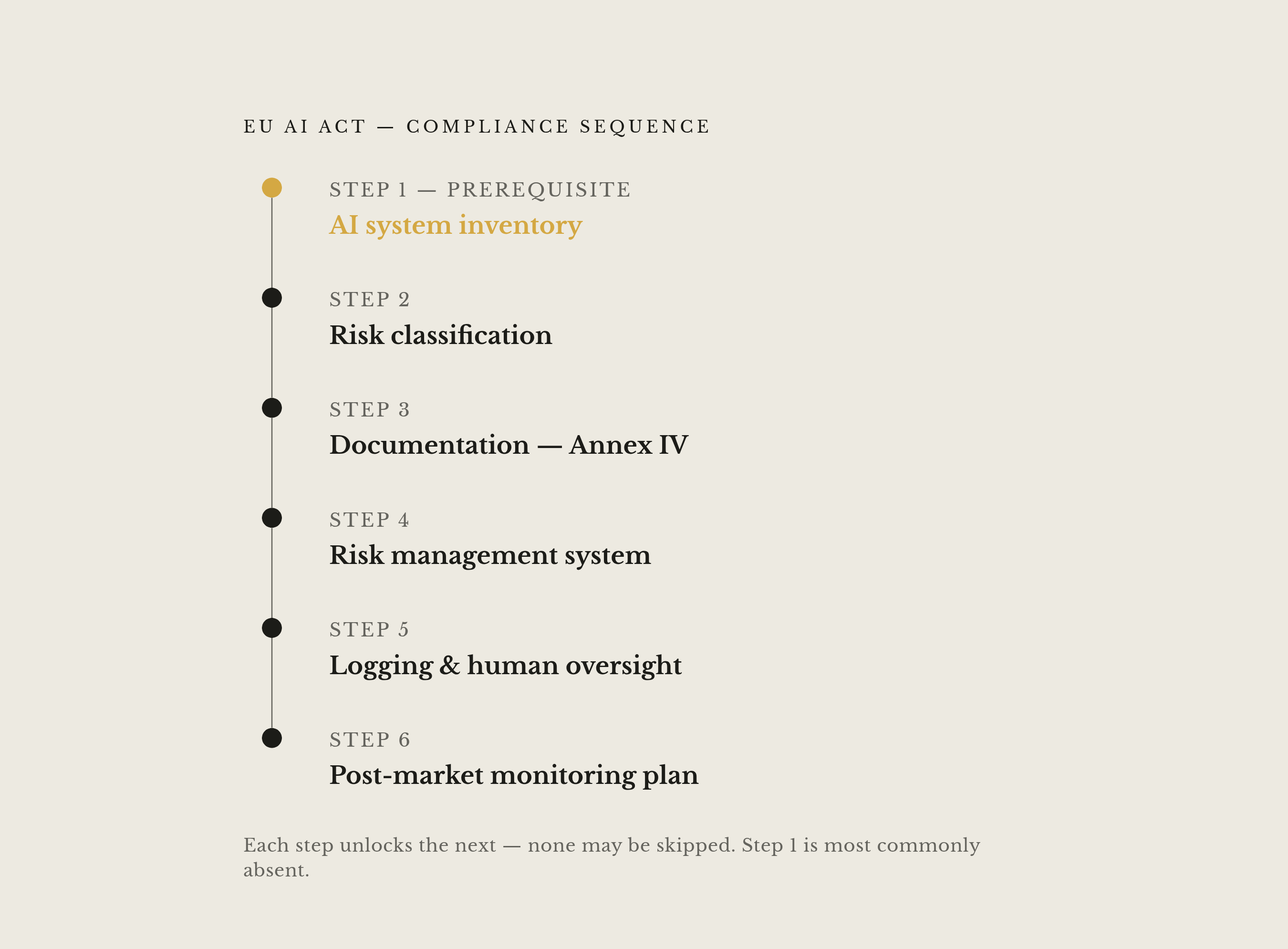
The practical sequencing is disciplined and non-negotiable: AI system inventory, then risk classification, then a documentation program scoped to Annex IV, then a risk management system established, then logging and human oversight designed into systems, then a post-market monitoring plan in place. Each step depends on the previous one, and none can be skipped. Enterprises that begin this sequence now will reach December 2027 with an architecture in place. Those that wait will still be compiling an inventory when the deadline arrives.
Methodology & sources
- EU AI Act High-Risk Deadline: Enterprise Readiness Gap
Provided the recurring enterprise evidence gaps, such as missing AI inventories, log retrieval, and AI-specific incident response.
- Article 11: Technical documentation
Supplied the Article 11 requirements: documentation must exist before market placement, be kept current, and SMEs may use a simplified Annex IV form.
- EU AI Act Guide
Informed the overview of high-risk classification, Annex III use cases, and the Articles 9 to 15 provider and deployer obligations.